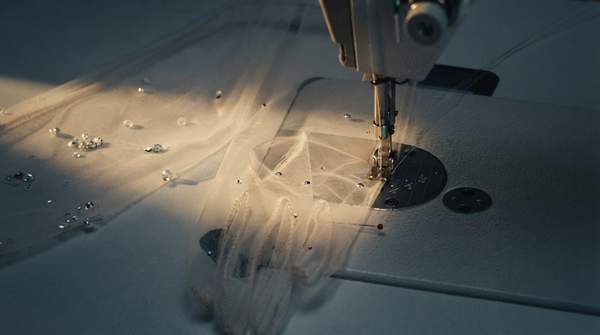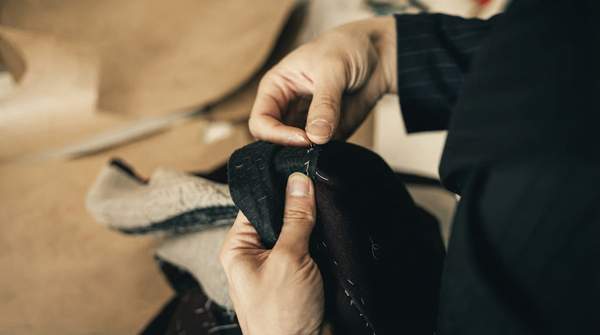
Haute couture embroidery rests on two distinct crafts that are often confused: Luneville hook embroidery, a French technique that works a chain stitch from the reverse of the fabric to attach beads and sequins at speed, and goldwork, the centuries-old art of couching metallic threads onto a fabric's surface. The essential difference is mechanical. Luneville is defined by a hook and speed of embellishment; goldwork is defined by metal threads that are laid, not sewn, and secured with fine couching stitches. Understanding the tools, materials, and history of each reveals why couture houses deploy them for entirely different aesthetic effects.
Introduction to Haute Couture Embroidery
Embroidery is the decorative signature of haute couture, and within the ateliers that supply the great fashion houses, a small number of technique families dominate the collections. Writing on the specialist houses that serve couture, embroiderer Franck Delorme identifies four families of techniques that make up most collections, among them the Luneville hook—used at the celebrated ateliers Lesage, Montex and Hurel—and gold thread and purl work, inherited from ornamental embroidery and reserved for ceremonial pieces.
These are not interchangeable skills. The Luneville hook produces a continuous chain stitch worked from the back of the fabric, applying pre-strung beads and sequins far faster than a needle could. Goldwork, by contrast, is a surface discipline in which precious metal threads are held in place by fine silk stitches. The Fondazione Lisio's couture embroidery program describes Luneville crochet embroidery as the technique most widely used in haute couture, prized precisely because it allows faster and more precise applications of beads and sequins than needle embroidery.
Goldwork: A Legacy of Metallic Splendor
Goldwork carries one of the oldest pedigrees in Western embroidery. According to the School of Stitched Textiles, the technique dates back to the twelfth century in the UK, when England was the epicenter of gold embroidery. The work was done almost exclusively by professional male embroiderers in London workshops and was known as Opus Anglicanum—a Latin term translating to "work of the English." These medieval embroiderers employed a remarkable technique called underside couching: working with the piece upside down, they pulled golden threads from the front to the back using a silk couching thread, producing weighty, valuable designs completely covered in gold.
The materials remain central to goldwork's identity. The School of Stitched Textiles notes that the technique is really a generic term for metal work, since modern threads come in copper, silver, and several shades of gold. Japanese thread, a gold metal exterior wrapped around a strand of cotton, is never sewn through the fabric; it is couched, traditionally in strands of two. Rococo thread, a fine wire tightly wrapped around a cotton core, is likewise couched, and being more malleable than Japanese thread, it permits more sinuous, "wiggly" lines. Because these metal threads cannot pass through fabric, goldwork uses few stitch types: a small, right-angled couching stitch holds the laid threads down, and specialist needles and padding materials are required to work with them.