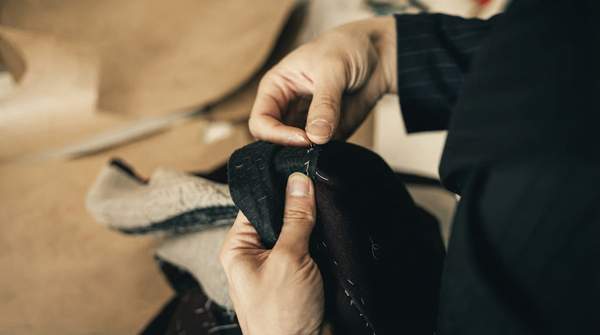
When a bespoke tailor pads a lapel by hand, they are doing something deceptively simple: working a series of short, diagonal stitches through two layers — the outer cloth and a canvas interlining — while deliberately leaving those stitches slack and shaping the work over a finger as they sew. That combination of stitch geometry, controlled tension and built-in curvature is what produces the soft, three-dimensional roll that machine stitching cannot replicate. The technique is, in the words attributed to master tailor Alessandro Cifonelli, "where art and engineering meet in perfect harmony."
The Art of the Hand-Padded Lapel: A Bespoke Hallmark
The lapel is the most visible place where hand padding earns its keep. Pad stitching, the underlying technique, appears in the lapels, collar and chest of a tailored garment, where it attaches the canvas interfacing to the outer cloth. But it is at the lapel that the result is on daily display: the way the cloth curves away from the chest, how it sits rather than lies, and the faint life in the fabric that comes from hundreds of individually placed stitches.
Writing on the tailoring site Permanent Style, Simon Crompton observed that the general three-dimensional shape of a chest would not be achievable without handwork, and that the particular style of an Anderson & Sheppard front depends on the coatmakers' specific techniques. That observation generalises to the lapel: the roll is not an afterthought pressed into the garment, but a shape locked into the layers as they are joined. This article focuses on the lapel; it does not treat the collar and chest in detail, and it is not a sewing tutorial.
Anatomy of the Pad Stitch: Geometry and Materials
Two elements make the pad stitch what it is. The first is the canvas interlining, the layer that does the structural work. As De Oost Bespoke Tailoring explains in a guide by Jean-Paul Samson, the canvas provides the foundational structure for the lapel; it is shaped and manipulated so that the finished lapel sits smoothly and correctly. The outer cloth — typically wool — contributes the appearance, but it has little independent architecture of its own.
The second element is the stitch itself. The stitches are short, diagonal, and worked in offset rows, so that each row catches a slightly different line through the canvas and the cloth. Crucially, they are not pulled tight. Where machine stitching applies uniform tension across a straight seam, hand padding lets the tailor vary both tension and placement from stitch to stitch, catching only a minimal, near-invisible amount of the outer cloth. The result is a join that holds the layers together while leaving the fabric free to move — flexible, not fused stiff.