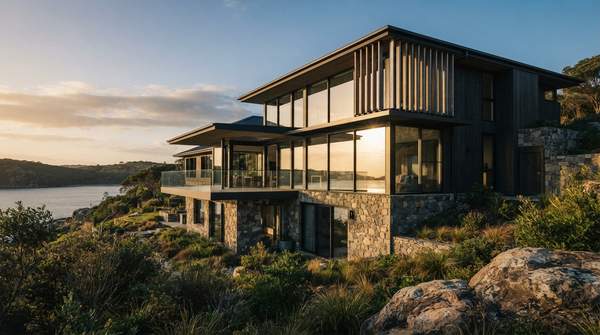
Sustainable luxury architecture rests on three core principles: passive design that works with sun, wind, and shade instead of mechanical systems; material selection judged across a building's full lifecycle; and site-specific design that adapts a residence to its particular climate and terrain. Practicing architects describe these not as constraints on high-end living but as the very source of its comfort, character, and longevity. A desert residence in Eastern Washington's Columbia Valley, designed by Garret Cord Werner Architects & Interior Designers, shows how all three can be integrated into a single cohesive home.
The Rise of Sustainable Luxury Architecture
Luxury clients are increasingly attentive to their environmental footprint, and architects have responded with a design ethos that prioritizes energy efficiency, resource conservation, and biophilic design—what Coates Design Architects describes as an approach that no longer asks anyone to sacrifice comfort or style. The firm's view is that eco-friendly and high-end have effectively converged: the era of compromise is over.
The underlying objective is straightforward. As the sustainable-building guide from Breathe Australia frames it, the goal of sustainable architecture is to reduce energy consumption, carbon emissions, and waste across a house's construction, operation, and maintenance. What distinguishes the luxury segment is that these reductions are pursued through means that also heighten sensory richness—texture, warmth, craftsmanship—rather than through austerity.
Core Principles of Sustainable Luxury Design
Three principles recur across the design philosophies of firms working in this space. Passive design treats sun, wind, and shade as free natural resources to light, heat, and cool spaces, working with the specific conditions of a site. Material selection looks at lifecycle costs, durability, embodied energy, and local sourcing—Propel Studio Architecture, for instance, favors natural materials that age gracefully, contain low or no toxic ingredients, emit few volatile organic compounds, and can be recycled or reused. Site-specific design, finally, adapts the structure to local climate challenges and its natural surroundings, so the home works with the land rather than against it.
The table below compares these principles by their environmental goal, their typical application in a luxury context, and the dual benefit each delivers.