The visual drama of a fine marquetry panel is not carved relief: it is a flat surface on which depth, shimmer and sharp pictorial contrast are manufactured from thin veneers, shell and metal. The effects that make a piece read as luxurious — graduated shadows, iridescent highlights, crisp figurative lines — each trace back to a specific craft decision, from scorching veneer edges in hot sand to orienting grain so light reflects differently across adjacent pieces. Understanding that mapping is what separates admiration from connoisseurship, and it is the framework this article sets out.
The Art of Marquetry: Crafting Visual Narratives in Luxury Furniture
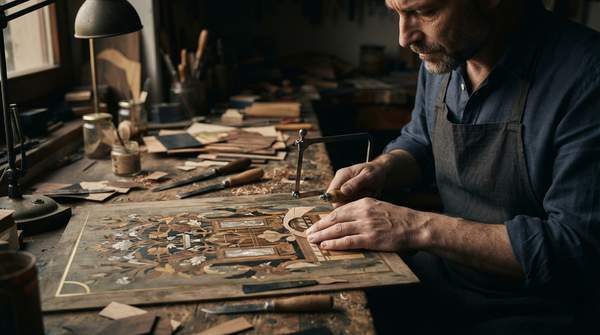
Marquetry is a decorative technique and craft that involves cutting and fitting together thin pieces of veneer, primarily wood, but also materials like shell, metal, bone, ivory, or mother-of-pearl, onto a surface to form patterns or designs. Each piece is shaped individually, the joins are seamless, and the finished panel remains flat rather than carved in relief. The design, in the studio's phrasing, "reads through grain, figure and tone, not depth."
The craft must be distinguished from its neighbors. OscarOno Paris, a marquetry flooring specialist, tabulates the difference: marquetry uses shaped pieces of veneer cut and fitted together into one panel, producing composed motifs, borders and pictures; parquetry uses straight-edged pieces in repeating geometric patterns such as herringbone or chevron; and inlay sets wood, metal, stone or shell into a recess cut in a solid surface. The antique dealer M.S. Rau adds that the distinction between inlay and marquetry is subtle, with inlay describing furniture in which a primary material is cut out to receive areas of another for decorative effect.
A Craftsman's Palette: Materials Beyond Wood
Wood veneer is the heart of the craft. Make Bespoke lists common species — oak, maple, sycamore — alongside exotic and precious woods such as ebony, rosewood, satinwood and figured burrs, prized for their rarity and grain. Dyed veneers extend the palette into consistent blues, greens and greys, allowing the same design to be re-veneered in a different colourway for each interior scheme.
Beyond timber sit the materials that catch light: mother of pearl, abalone and shell for iridescence, and metal inlay for line and contrast. The historical palette was broader still. Lemieux et Cie traces marquetry's origins to ancient civilizations, where craftsmen used precious woods, ivory and other materials to adorn furniture and architectural elements. Where historical work used ivory, bone and tortoiseshell, Make Bespoke now uses ethical faux alternatives and acrylic sheet — materials the studio says cut cleanly, hold colour and avoid harm. The most famous historical pairing of materials, brass with tortoiseshell, is described by Magic Eraser's Maya Rodriguez as producing opulent decorative results in two mirror configurations, première-partie and contre-partie.