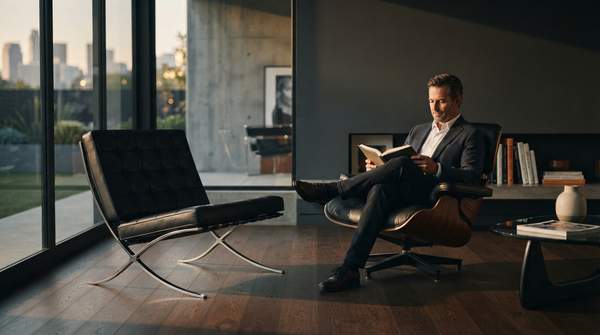
The Barcelona Chair and the Eames Lounge Chair stand as two of the most iconic and enduring designs in modernist furniture, each representing distinct philosophies that continue to shape luxury interiors. While both are celebrated for their timeless appeal, their foundational design intents, material innovations, and aesthetic impacts diverge significantly. Understanding these differences is crucial for design connoisseurs and interior decorators seeking to make informed aesthetic and functional choices for sophisticated spaces.
The Barcelona Chair, introduced in 1929, embodies European structural formalism, conceived as a public statement and an architectural "throne" for royalty. In contrast, the Eames Lounge Chair, launched in 1956, reflects American ergonomic humanism, prioritizing comfort through innovative molded plywood technology. This comparative analysis delves into their core design principles, material applications, and lasting influence, providing a structured understanding of their historical significance and contemporary relevance.
Foundational Design Philosophies: Formalism vs. Humanism
The core distinction between the Barcelona Chair and the Eames Lounge Chair lies in their fundamental design philosophies. Designed by Ludwig Mies van der Rohe and Lilly Reich for the 1929 Barcelona International Exposition, the Barcelona Chair was not primarily intended for sitting comfort. Instead, it was conceived as an authoritative, modern "throne" for King Alfonso XIII and Queen Victoria Eugenia during their visit to the German Pavilion, embodying structural formalism.
Every element of the Barcelona Chair, from its X-shaped chrome frame to its flat, tufted cushions, was designed to appear architectural, almost as an extension of the building itself. Its purpose was to make a public statement, reflecting the Weimar Republic's modern identity without resorting to traditional royal iconography. This approach resulted in a piece that is striking, structured, and sculptural, serving as a formal accent rather than a primary comfort item.
Conversely, the Eames Lounge Chair, created by Charles and Ray Eames in 1956, pursued an almost opposite goal: comfort first, formality second. Charles Eames famously desired the chair to possess "the warm, receptive look of a well-used first baseman's mitt," emphasizing a human-centered, ergonomic approach. This design philosophy aimed to provide a deep, reclining seat built purely around relaxation, a chair one could sink into after a long day.
The Eames Lounge Chair was envisioned as a private object for a creative person's home, prioritizing the user's experience. Its construction from curved plywood shells and leather cushions was specifically engineered to cradle the body, reflecting a philosophy of ergonomic humanism that focused on domestic comfort and personal well-being.