Modernist furniture was not born from a sketch alone: it was born from a factory process. Two industrial materials—bent tubular steel and molded plywood—made the movement's most iconic chairs physically possible, and each pushed design in a different direction. Tubular steel gave Bauhaus designers such as Marcel Breuer lightweight, continuous frames suited to mass production, while molded plywood, refined after decades of adhesive failures, enabled the organic, sculptural forms that defined post-war design.
Introduction: Modernism's Material Revolution
The modernist credo, as expressed at the Bauhaus, was to choose a material for what it does, show how it is made, and avoid applied ornament. The school's workshops produced lamps, furniture and textiles for industrial manufacture rather than one-off craft objects, and that commitment to industrial production demanded industrial materials. Writing on modernist architecture and design, Emily Reyes notes that Marcel Breuer's tubular steel furniture, developed at the Bauhaus in the mid-1920s, used bent steel tube of the kind made for bicycles—a deliberately industrial starting point for a domestic object.
Plywood followed a parallel logic. As an editorial feature from Curationist explains, the spread of the steam engine in the 19th century spurred wood-bending techniques and pushed furniture designers toward fabrication methods that could be scaled for mass production. These developments reached what that account calls a "transformative apex" in the mid-20th century, when designers and manufacturers pioneered ways of molding plywood—a composite material that reconfigured the structural and aesthetic properties of natural wood itself.
Tubular Steel: The Bauhaus and Industrial Elegance
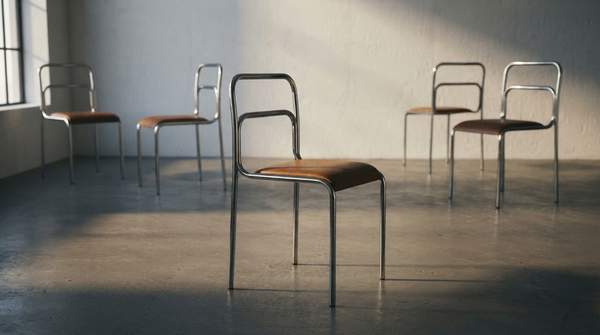
The Bauhaus philosophy of uniting art with industrial manufacturing found its most literal expression in steel tube. Because the material is hollow, it is light; because it is steel, it is strong; and because it can be bent in continuous curves, a single tube can run from armrest to seat to base without joints or applied decoration. The result was furniture whose structure is its ornament—an exposed skeleton of gleaming, chrome-plated lines.
According to RCT Manufacturing, a UK maker of tubular furniture writing on the material's history, this approach offered a sleek, functional aesthetic that gained popularity through its association with modernism and industrial design principles. The durability, versatility and lightweight character of metal tubular furniture made it practical for both residential and commercial spaces, and as the mid-century modern movement took hold, metal furniture became shorthand for progressive design. The tubular structure itself, the same account explains, boosts overall strength, allowing pieces to withstand heavy loads and frequent use without losing integrity.
Molded Plywood: Evolution and Organic Forms
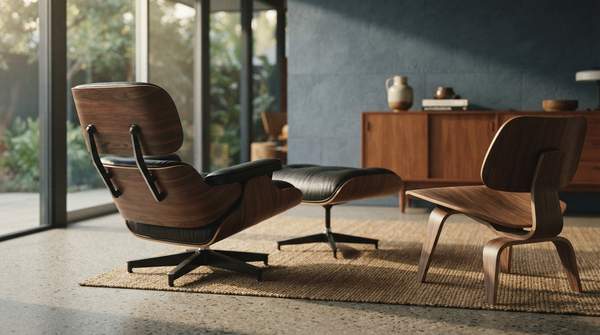
Molded plywood's history is a story of a good idea waiting for chemistry to catch up. Thonet, the German furniture firm that pioneered bentwood, recounts that gluing thin layers of wood together is by no means a modern discovery—the ancient Egyptians used veneers and plywood for furniture and wagons, with evidence of similar objects in ancient China and Rome. The modern process layers thin wood veneers with adhesive, then presses them under heat and pressure into flat sheets or complex three-dimensional objects, allowing the resulting cuts to bear weight in all directions.
The early attempts failed in practice. Thonet's own history records that when the company shipped its Boppard armchairs to South America, the glue could not withstand the warm, humid climate. Bent solid wood proved more robust, and glued laminated wood fell out of use at Thonet for roughly half a century—until more durable glues and optimized manufacturing techniques arrived. After the Second World War, the company's account continues, molded plywood became the material of the day and a driver of innovation, as a love of organic design brought lightness and life into interior spaces.
Key Designers and Iconic Pieces
Marcel Breuer is credited with the initial tubular steel innovation: inspired, as the Bauhaus account describes, by bicycle handlebars, he developed his Wassily Chair between 1925 and 1926, along with cantilever designs that eliminated rear legs entirely by exploiting the tube's springy strength. Ludwig Mies van der Rohe carried the vocabulary further with pieces such as the MR Armchair, refining the cantilevered steel frame into an even more restrained statement of structure.
On the plywood side, Michael Thonet's 19th-century experiments laid the technical foundation, even though his adhesives were not yet equal to the task. Alvar Aalto and Charles and Ray Eames later advanced molded plywood into the defining material of organic modernism, exploiting its capacity for sculptural, ergonomic curves that traditional solid woodworking could not achieve. The same molding process, Thonet notes, produced elegantly curved chairs, sleek boat hulls and aircraft fuselages—evidence of how far the material could be pushed beyond the furniture workshop.
Comparing Tubular Steel and Molded Plywood in Modernist Design
Set side by side, the two materials reveal how modernism's single philosophy produced two distinct aesthetics. Steel answered the movement's demand for industrial honesty and mass production with minimal, open frames; plywood answered its demand for material truth with forms that followed the human body. The table below isolates each material's contribution.
| Dimension | Tubular Steel | Molded Plywood |
|---|---|---|
| Material properties | Outstanding durability and impressive strength; lightweight, hollow tube suited to furniture-scale structures | Flexible and strong; layered veneers bear weight in all directions, allowing complex curves |
| Key innovators | Marcel Breuer pioneered the approach; Mies van der Rohe developed it further | Michael Thonet pioneered bentwood foundations; Alvar Aalto and Charles & Ray Eames advanced it into iconic designs |
| Manufacturing process | Bending hollow steel tubes into continuous forms, enabling new structural possibilities | Layering thin wood veneers with adhesive, pressed under heat and pressure into two- or three-dimensional shapes |
| Resulting aesthetic | Minimalist, industrial and functional—clean lines and an open, airy feel aligned with Bauhaus principles | Organic and biomorphic—sculptural, ergonomic forms that brought lightness into interiors |
| Iconic examples | Breuer's Wassily Chair (1925–26) and cantilever chairs; Mies van der Rohe's MR Armchair | Thonet's Boppard armchair experiments; post-war organic designs by Aalto and the Eameses |
The comparison shows the causal link at the heart of modernist design: the bending of a steel tube produced the cantilever, and the heat-pressing of veneers produced the sculpted shell. Neither form could have been drawn into existence by style alone—each depended on a fabrication technique arriving at industrial maturity.
The Enduring Legacy of Material Innovation
Modernist furniture design fundamentally shifted because of the innovative application of industrial materials like tubular steel and molded plywood, establishing a lasting aesthetic and functional paradigm. Both materials embodied what Thonet calls the enthusiasm of modernism—the beginning of a new era—alongside chrome-plated steel and concrete. Their trajectories also share a lesson: innovation is a process of refinement, not a single invention, as plywood's half-century of dormancy between Thonet's glue failures and post-war adhesives demonstrates.
The measurable indicator of this legacy is the continued influence of these material-driven designs in contemporary furniture and interior trends. RCT Manufacturing observes that metal tubular furniture remains a favored choice for those seeking a blend of form and function, its enduring appeal and timeless elegance keeping it a staple of modern interiors. For the reader tracing any modern chair back to its origins, the decisive question is a material one: whether its form flows from a bent steel line or a pressed veneer curve—and, in either case, from a manufacturing breakthrough that made the form possible.