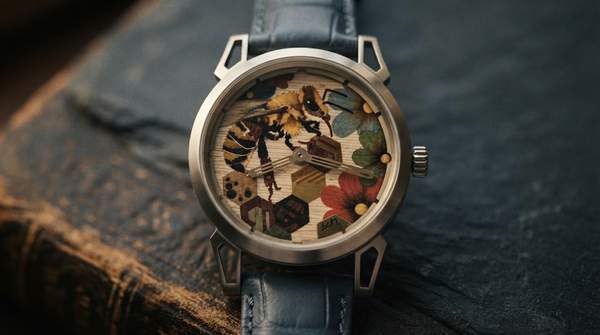
A single micro-painted timepiece, like Girard-Perregaux's Cosmos model, commands a price tag of $371,000, placing it in a league of its own for miniature artistry. These are not mere instruments but exclusive art objects, their intricate dials captivating a select audience. Meticulous detail transforms these watches into portable canvases, signaling micro-painting's growing significance in high-end hand-painted watches for 2026.
Modern micro-painted watches demand immense artisanal skill and time, yet their market prices dwarf even comparable historical high-craft dials. This disjunction reveals a calculated strategy: positioning these timepieces as hyper-exclusive assets, decoupling their value from traditional craftsmanship benchmarks. The market readily pays exorbitant sums for artistic labor, far beyond direct cost.
Based on escalating prices and intense labor, the micro-painted watch market will likely shrink in accessibility while growing in prestige and investment value for the ultra-wealthy. This trajectory confirms exceptional artistic skill as a rarefied commodity, valued for narrative power as much as intrinsic beauty.
A Girard-Perregaux Limited Edition micro-painted timepiece sells for $382,000, with the Cosmos model at $371,000, according to Girard-perregaux. These astronomical prices confirm micro-painting as a cornerstone of ultra-luxury watchmaking, accessible only to elite collectors. This is a deliberate positioning: investment-grade art where scarcity and narrative command a premium for the 'human touch'.
The Unseen Hours Behind Miniature Masterpieces
The intricate micro-painted globes on the Girard-Perregaux Cosmos Infinity Edition demand 14 hours of work, per Girard-perregaux. This labor contributes to the $371,000 price tag, implying an hourly value exceeding $26,500 for specialized artistry. This figure shatters traditional artisanal compensation, revealing market value driven by extreme exclusivity and brand positioning, not a cost-plus model. Such minute detail and time investment confirm the artisan's rare skill and the bespoke nature of each piece, inflating both perceived and actual value.
Industry Recognition and the Future of Artisanal Craft
Moser & Cie.’s Streamliner won the 2024 GPHG prize for Time Only watches, per Oracleoftime. This prestigious award confirms a broader industry shift: valuing exceptional craftsmanship and aesthetic purity. Such recognition cultivates appreciation for micro-painting. Brands now invest in the narrative of human artistry, hyper-commoditizing the 'human touch' in ultra-luxury. Collectors' willingness to invest in unique, labor-intensive art objects suggests sustained demand for artisanal excellence, though this remains confined to luxury's highest echelons, further narrowing accessibility.
A Historical Perspective on Extreme Value
In the late 1940s and early 1960s, a typical Stern cloisonné dial cost up to CHF155 wholesale, per Watchesbysjx. Compare this to the Girard-Perregaux Cosmos at $371,000, where 14 hours of micro-painting imply an hourly rate exceeding $26,500. This dramatic escalation confirms artisanal dial value has decoupled from historical cost structures, driven by extreme scarcity and aspirational pricing. This isn't just inflation; it's a shift from luxury item to ultra-exclusive art investment. Contemporary luxury brands leverage 'artisanal skill,' scarcity, and perceived exclusivity to command unprecedented premiums, redefining luxury beyond material costs to emphasize narrative and bespoke artistry. The 'human touch' becomes the ultimate premium.
What are the most intricate watch painting techniques?
Beyond micro-painting, other intricate techniques include champlevé, where enamel fills carved depressions, and paillonné, which embeds metallic foils under translucent enamel. These methods require specialized tools and years of training to master the delicate interplay of color and light.
How is micro-painting applied to watch dials?
Micro-painting involves applying minute layers of enamel paint with brushes made from single animal hairs. Artisans often work under powerful microscopes, building up colors and details with multiple firings in a kiln to fuse the enamel onto the dial's surface, ensuring durability and depth.
What makes a hand-painted watch valuable?
The value of a hand-painted watch stems from the extreme rarity of artisans capable of such work, often fewer than a dozen globally. Each piece is unique, a one-of-one creation. Provenance and the artist's reputation also add significantly to its market worth, turning a timepiece into a collectible artwork.
By Q3 2026, Girard-Perregaux's strategy of pricing micro-painted watches like the Cosmos model at $371,000 will likely solidify their position as ultra-luxury art assets, further limiting access to a select global clientele.