The most compelling luxury hotels in Beijing today do not compete on chandeliers or marble lobbies; they compete on architectural narrative. Two properties in the same city illustrate the divide with unusual clarity. The Opposite House, designed by Kengo Kuma for the Taikoo Li Sanlitun complex, embodies urban modernism—a minimalist, light-filled sanctuary within a bustling commercial district. Mandarin Oriental Qianmen takes the opposite path: 42 restored courtyard houses woven into a historic hutong quarter, where guests live inside centuries of Beijing's urban fabric. Choosing between them is choosing between two distinct ways of experiencing a city.
The Evolution of Luxury Hotel Design: Beyond Opulence
Across the past three decades, a select group of hotels has fundamentally reshaped what luxury means. As one design retrospective puts it, modern luxury hotels are "no longer defined solely by opulence or excess" but have become cultural touchstones—spaces where architecture, design, and experience converge to reflect contemporary values, speaking to a global audience fluent in aesthetics, sustainability, craftsmanship, and emotional resonance.
The consequence is that architecture itself has become the experience rather than a symbol of status. In the most influential properties, spatial sequencing, natural light, and material continuity actively guide movement and perception: arrival is choreographed, transitions are intentional, and moments of pause are carefully designed. Interiors, in turn, give these buildings their soul through a refined balance of comfort, craftsmanship, and conceptual clarity.
Architecture firms specializing in hospitality describe the same shift from the practitioner's side. Writing for Nunzio Marc DeSantis Architects, Christina Straughan notes that boutique hotels now express luxury through unique details—custom artwork, local artisanal furnishings, personalized service—so that guests feel "both pampered and connected to the hotel's story." Luxury, in this framing, often lies in surprise and delight: a secret garden behind the pool, a private library accessible only to select guests. The common thread is authenticity rooted in place, and it is precisely this standard that both Beijing properties answer, in radically different ways.
Urban Modernism: The Opposite House's Minimalist Sanctuary
Kengo Kuma is the Tokyo architect whose practice became the most internationally celebrated in Japan following his work on the 2020 Tokyo Olympic Stadium, and whose material philosophy—wood, stone, natural textures, and the dissolution of the boundary between interior and exterior—has influenced a generation of luxury hotel design. He designed The Opposite House in 2008 for the Taikoo Li Sanlitun complex, and the building is regarded as a minimalist masterpiece within that urban setting.
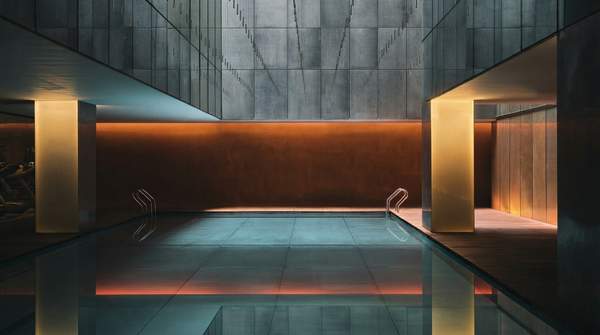
The hotel's design emphasizes light and shadow, using its translucent emerald-green glass exterior and open-plan interiors to create a sense of calm and spaciousness amid one of Beijing's most commercial districts. The guest experience follows directly from these choices: rather than buffering visitors from the city with ornate formality, the architecture offers a serene, contemporary escape whose tranquility is defined against the bustle outside. It is urban modernism in the fullest sense—luxury achieved through restraint, material honesty, and the deliberate choreography of light.