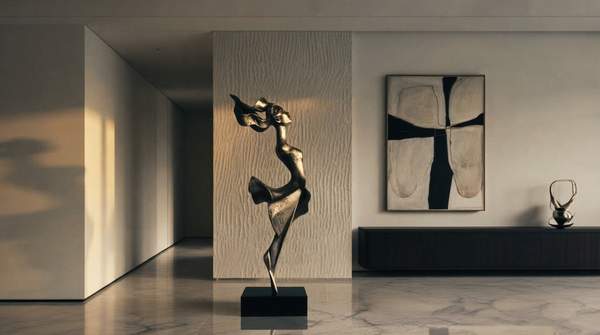
Building a significant private collection of modernist sculpture is less a matter of budget than of method. The collectors who succeed move through a deliberate sequence: they define what the collection should express, plan acquisitions strategically, source works through reputable channels, and verify provenance and condition before committing. Advisory practices and collecting guides converge on this structure, and sculpture adds a distinctive complication—unlike two-dimensional art, it transforms the space around it, so every purchase is also a spatial decision. This guide lays out that process for aspiring private collectors; it does not cover institutional acquisitions, and it does not replace professional valuation, authentication, or conservation services.
A Four-Stage Framework for Modernist Sculpture Acquisition
The framework below organizes the acquisition process into four sequential stages, each with a defining question and a concrete action. Its value is cumulative: a collector who resolves Stage 1 honestly will make faster, more confident decisions at every later stage, because each candidate work can be tested against an established criteria rather than judged on impulse.
| Stage | Key Consideration | Collector Action |
|---|---|---|
| 1. Define Collection Focus | Personal values, goals (enjoyment vs. investment), and the styles, periods, or artists that give the collection its identity | Research what resonates; set a theme or focus; categorize by medium, artist, or period |
| 2. Plan Budget & Acquisitions | Quality over quantity; tiered spending matched to collector level; long-term goals | Set a budget and strategy; prioritize the best available work over several minor examples |
| 3. Source and Identify Works | Reputable channels: galleries, art fairs, auctions, artist studios, private sales | Build gallery relationships; compare works in person for scale, material, and quality |
| 4. Conduct Due Diligence | Provenance, attribution, exhibition record, condition documentation; heightened scrutiny for foreign-origin works | Commission research where needed; engage independent specialists by agreement; document everything |
Stage 1: Defining Your Collection's Vision
A collection, as the independent advisory practice Theresa Rézeau Fine Art puts it, should reflect more than what you can acquire—it should reflect what you value. The decision to acquire a work begins long before the purchase, with understanding the piece, its history, and the place it might hold within the whole. Powell Fine Art Advisory makes the same point from the collector's side: the first step is not necessarily choosing a period or medium, but learning to recognize what resonates—a palette, a material quality, a subject, or the feeling a work creates within a space.
From there, structure emerges. Elliott Gallery's beginner guidance recommends defining a central theme or focus, which gives the collection visual harmony and deepens expertise in a niche. Artwork Archive suggests categorizing by technical factors such as medium, artist, time period, and type of work. For modernist sculpture specifically, that might mean a focus on the early twentieth-century departure from classical figuration, on a single material tradition, or on a defined era. Susannah Morgan, writing in Worthwhile Magazine, frames the payoff plainly: clear criteria make decision-making easier when you are looking at potentially hundreds of pieces.