An investment-grade vintage Rolex is not defined by its model name but by a verifiable combination of originality, provenance, and condition — and the differences that separate a collector-grade piece from dead money are often invisible to an untrained eye. Specialist dealer James Patten Fine Watches, writing in 2026, put the distinction bluntly: vintage Rolex is "genuinely investment-grade in the right reference, and dead money in the wrong one," and what separates the two "comes down to originality." The practical answer for any buyer is a systematic three-pillar evaluation before committing funds.
The Three Pillars of Investment-Grade Vintage Rolex
The framework rests on three pillars that specialist dealers consistently identify as the drivers of long-term value. First, originality: whether the dial, hands, bezel, case, and bracelet are the parts the watch left the factory with. Second, provenance: whether the watch's history is traceable through its box, papers, and service records. Third, condition: whether the case has been over-polished and the movement remains healthy.
Market behavior confirms the framework's relevance. Bob's Watches' 2025 vintage market report, authored by Brandon Frazin, observed that collectors moved away from short-term hype and anchored purchases "in history, condition and long term appeal," with buyers focusing "more intently on dial variations, production eras and completeness." Frazin also noted buyers increasingly sought to understand "the subtle nuances between production years, dial types, and case details" — details that, as Bob's Watches' buying guide warns, "can often account for thousands of dollars in resale value."
One caveat frames everything that follows: the market normalized after the 2021–2022 peak, and while prices on common vintage pieces settled toward realistic levels, references with genuine rarity — a specific dial, a specific bracelet, a documented history — retained demand from serious collectors, according to James Patten Fine Watches. This guide describes evaluation criteria, not guaranteed returns.
Pillar 1: Verifying Originality and Subtle Value Drivers
Originality is where the largest value gaps hide, and the dial is the most consequential component. Golden Anvil Jewelers' investing guide, authored by Sara Feinstein, lists the core verification points: serial and reference numbers, original parts including the dial, hands, and bezel, and box and papers. Its warning is direct — replacement dials or polished cases reduce long-term value.
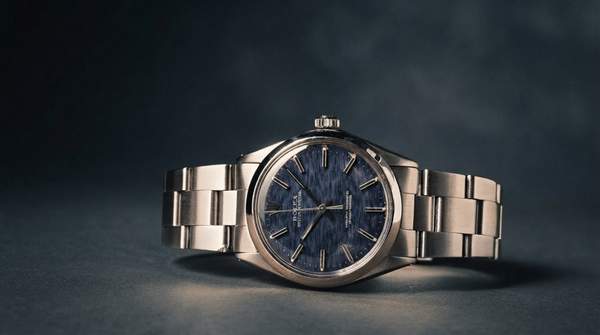
Dial variations illustrate how nuance becomes price. James Patten Fine Watches' 2026 guide compares two Rolex Datejust 1601 references: a "Wide Boy" example listed at A$10,900 with box and original bracelet, recommended "for completeness," and a Champagne Linen-dial example at A$12,999 that "carries a dial premium" and is rated "consider, not a default buy." Two watches of the same reference, separated by roughly A$2,000 in asking price, differ primarily in dial type and completeness — the kind of distinction that only matters to a buyer who knows to look for it.
The bracelet deserves equal scrutiny. Thayer Jewelers' guidance on choosing a pre-owned Rolex notes that for a collector pursuing a specific vintage reference, "original period-correct parts, an unaltered dial, and a matching bracelet may justify a premium." James Patten Fine Watches goes further operationally: skip any vintage Rolex missing an original, matched bracelet, because resale liquidity drops fast. A period-correct, matched bracelet is therefore not a cosmetic detail but a liquidity safeguard.