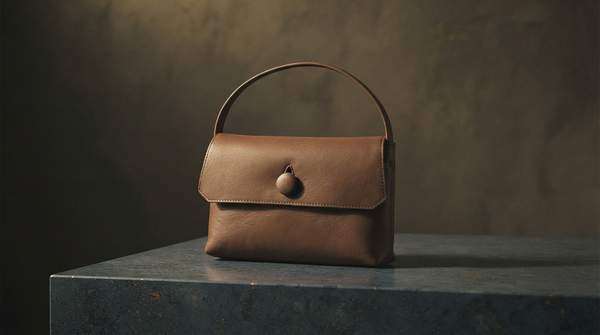
What distinguishes a bespoke leather bag from a factory-made one is rarely visible at first glance—it lives in the seam and the edge. Two construction choices matter most: the saddle stitch, performed by hand with two needles and a single waxed thread, and the edge finish, where raw leather is burnished, waxed, or painted into a sealed, polished surface. Behind both sits a material decision—vegetable-tanned, dyed-through hide—that determines how the piece ages. Understanding these three elements gives you concrete criteria for judging quality, not just a brand's word for it.
The Art of the Stitch: Saddle Stitch vs. Machine Lock Stitch
The saddle stitch is the defining hand technique of high-end leatherwork. As the Parisian atelier Duret Paris describes it, the stitch is "performed using two needles and a single strand of waxed linen thread," with each stitch individually knotted, providing what the house calls unparalleled strength and a finish of remarkable elegance. The two needles pass through the same hole from opposite sides, creating interlocking stitches that lock the seam independently at every point.
This structure is what makes the difference functional rather than merely aesthetic. Because each stitch is secured on its own, a break at one point does not undo the seam—the remaining stitches continue to hold the leather together. Machine stitching, by contrast, typically relies on a single thread running through the seam; if that thread breaks, the stitching can unravel along its length. Artisanal leatherworkers at Old Town Leather Goods add that the hand method maintains even tension throughout, preventing the weak points that uneven machine seams can introduce, while the waxed thread itself resists fraying and wear.
There is a trade-off, and it explains why the technique marks the luxury tier: saddle stitching demands what Duret Paris calls "absolute mastery of the craft" and considerable time, which is why it is reserved for exceptional pieces rather than production runs. An irregular or poorly executed seam, the atelier notes, can weaken a bag's entire structure—so the technique's presence alone is not a guarantee; its execution is.
Flawless Edges: Burnishing, Painting, and Their Impact
The cut edge of a piece of leather is its most vulnerable surface: exposed fibers absorb moisture, collect grime, and fray with friction. Mass-produced goods often leave edges raw or simply rolled, which is fast but leaves that vulnerability in place. Artisanal finishing closes the edge entirely, and practitioners describe several distinct methods for doing so.
Edge burnishing smooths and seals the raw edge into a polished, unified surface. Beeswax conditioning applies natural wax that enhances the leather's suppleness while adding durability, and hand polishing buffs the surface to a deep natural shine—Old Town Leather Goods lists all three as the essential final touches that protect the product's appearance and keep it functional for years. Edge painting, taught as a core skill in artisanal leathercraft courses, builds up specialized coats by hand to achieve a smooth, professional-quality finish.
The common principle across these approaches is that the edge is treated as a design and craftsmanship element in its own right, not an afterthought. A properly finished edge delivers two things at once: a refined appearance, and a sealed boundary that resists the wear and fraying that degrade an unfinished edge first. In practice, the edge is often where a bag's age shows first—making its treatment one of the most reliable indicators of how the whole piece was built.
The Foundation of Quality: Material Selection and Preparation
Construction technique can only do so much if the leather itself is poorly chosen. The material favored in bespoke work is vegetable-tanned hide—leather treated with natural tannins rather than mineral processes. It is the material of choice for artisanal projects, including the bespoke totes taught in specialized leathercraft courses, and it carries distinct characteristics: the tanning process is traditional and time-consuming, the leather is initially stiffer, and it softens with use while developing a rich patina over time.
Equally important is how the leather is dyed. Leathercraft Masterclass, a craft education platform, draws a sharp practical distinction between surface-coated and "struck through" or dyed-through leather. In dyed-through leather, the dye penetrates the entire thickness of the hide. In leather dyed only on the grain side—English bridle leather is cited as traditionally coated this way by hand—a deep scratch or scuff exposes the lighter, un-dyed leather underneath, and high-wear areas such as bag corners and piping reveal that pale core much sooner.
The evaluation advice the platform gives is direct: inspect the cross-section of a sample cut for any lighter core, especially in the center, and look for dyed-through leather for best results. This is why dyed-through matters for longevity rather than just appearance—scratches remain inconspicuous because the color continues through the fibers, so ordinary wear does not expose an untreated layer.
Artisanal vs. Mass-Produced Leather Goods: A Quality Comparison
The table below isolates the structural differences between hand and machine construction, and between finished and unfinished edges, to show their direct consequences for longevity and appearance.
| Technique | Artisanal Method | Mass-Production Method | Key Difference | Impact on Durability & Aesthetics |
|---|---|---|---|---|
| Stitching | Saddle stitch: two needles, one waxed thread, each stitch individually knotted | Machine lock stitch using a single thread | Interlocking stitches secure the seam at every point independently | A broken stitch does not unravel the seam; even tension prevents weak points; refined finish |
| Edge finishing | Burnishing, beeswax conditioning, hand polishing, hand-applied edge paint | Raw or simply rolled edges | The edge is sealed and treated as a design element rather than left exposed | Sealed edges resist wear and fraying; polished appearance holds up over years of use |
| Material selection | Vegetable-tanned hide, tanned with natural tannins | Commonly faster mineral-tanned leather | Traditional, time-consuming tanning produces a durable material | Initially stiffer, softens with use, develops a rich patina over time |
| Material preparation | Dyed-through ("struck through") leather with dye penetrating the full thickness | Surface-coated leather dyed only on the grain side | Color continues through the fibers rather than sitting on top | Scratches and scuffs stay inconspicuous; corners and piping do not reveal a pale core |
Read together, the rows show why these choices compound: a saddle-stitched seam in dyed-through, vegetable-tanned leather with sealed edges is protected at every level—seam, surface, and boundary—whereas a mass-produced piece leaves each layer exposed to the failure mode the artisanal method prevents.
Evaluating Quality: What to Look For in Luxury Leather Goods
When evaluating luxury leather goods, prioritize products that demonstrate clear evidence of hand saddle stitching, meticulously finished edges—burnished or painted—and materials described as dyed-through or vegetable-tanned, since these are the markers of superior durability and aesthetic longevity. The checkable indicators are: distinct, interlocking stitches that do not unravel easily; smooth, sealed edges without fraying; and consistent color throughout the leather's thickness, even in areas of wear.
Two caveats keep the evaluation honest. These techniques are characteristic of high-end artisanal goods but not exclusive to them, and their presence alone does not guarantee overall quality—a poorly executed saddle stitch can weaken a bag's structure, as Duret Paris itself warns. And this is an evaluation framework, not a repair manual: the techniques described are for identification, not for attempting the work yourself.
The practical test is simple and repeatable. Examine a seam closely for the two-needle stitch pattern and gently probe whether a single cut thread would compromise the seam. Run a finger along every edge, checking for a sealed, polished surface rather than exposed fibers. On a worn corner or a cut edge, look for uniform color through the leather's thickness. A piece that passes all three checks—stitch, edge, and core—carries the construction evidence that separates handcraft from the production line.
Sources
- Specialization in Artisanal Leather Crafting Techniques - Online Course — Domestika
- Fine Leathercraft. The 7 Signs Of Luxury — Leathercraft Masterclass
- The crafting secrets behind a luxury leather bag - Duret Paris
- The Art of handmade leather craftsmanship: A Journey of Craftsmanship — Old Town Leather Goods