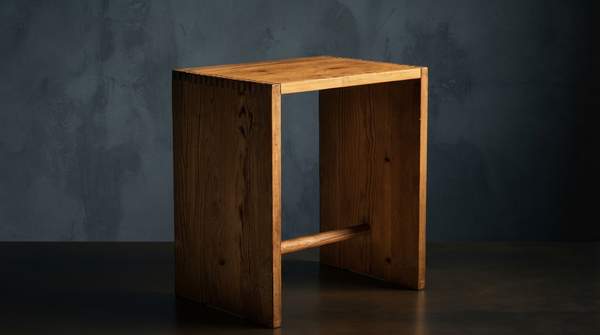
Japanese joinery builds furniture whose parts lock together so precisely that nails, screws, and often glue become unnecessary, and that single construction choice is what contemporary designers credit for pieces that are simultaneously stronger, cleaner to look at, and more sustainable than conventionally fastened alternatives. The method, refined over centuries by craftsmen working largely without quality iron, treats the joint itself as the structure. In modern furniture, that translates into seamless surfaces, uninterrupted grain, and pieces designed to be repaired rather than discarded.
The Enduring Philosophy of Japanese Joinery
The craft emerged from necessity: as furniture maker Erik Needham explains, joinery techniques were developed over centuries in an environment often lacking quality iron, pushing craftsmen to perfect methods that exploited wood's unique properties rather than fighting them. What began as constraint became philosophy. A study of Japanese design concepts and traditional joints for modern furniture observes that Japanese culture presents refinement, simplicity, aesthetics, and balance, integrating nature into the living space, and that traditional furniture's simple beauty fits that philosophy precisely.
The result is a construction ethic in which the joint is not hidden hardware but the visible argument of the piece. Japanese wood products, the same analysis notes, are uniquely crafted without nails or screws, relying on precise joinery for durability, yielding furniture that is both long-lasting and aesthetically pleasing. The joint geometry is not decoration; it is the load path, the fastener, and the ornament at once.
Precision and Permanence: Key Principles in Practice
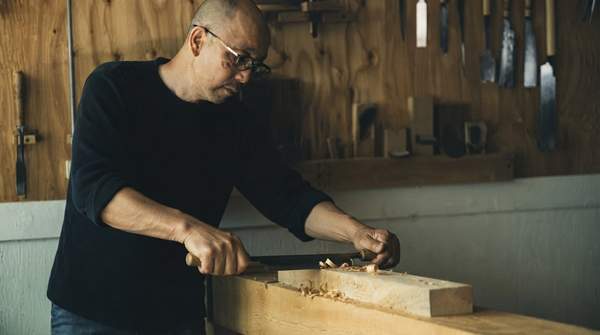
Two principles govern every joint: extreme precision and complete interlock. Writing on sashimono, the traditional Japanese furniture-making discipline, Andrew Cousins describes masters using only planers, chisels, and saws to make each cut manually, with angles, mortises, tenons, and tight tolerances working together to create joints that are "often invisible from the outside" yet "works of art from the inside." The strength comes from fit, not fasteners: a precisely cut joint distributes stress through the wood itself.
Material selection reinforces the geometry. Cousins notes that sashimono is traditionally made with Japanese wood species chosen for pronounced grain, high strength-to-weight ratios, and resistance to harsh environments, with cutting, treating, and finishing enhancing heat and moisture resistance while deepening the grain's natural beauty. Precision, in other words, extends from the saw line to the species choice, which is why the approach aligns with what engineers call design for reliability: products built to endure rather than to be replaced.
Essential Joints: Mortise and Tenon, Dovetail, and Lap Joints
Three named techniques carry most of the load in contemporary work. The mortise and tenon is the fundamental right-angle connection: a projecting tenon on one piece fits into a precisely cut mortise, or cavity, in its mate, locking the members together through geometry alone. It is the workhorse joint wherever a rail must meet a leg or a frame must resist racking.
The dovetail interlocks wedge-shaped tails on one board with matching pins in another, so that the harder the joint is pulled, the tighter the wedges bind. Needham identifies it, alongside mortise and tenon and lap joints, as an essential technique offering structural strength without compromising the beauty of the wood grain. Its contemporary relevance is documented in designer Yuma Kano's 2017 Shizuoka work, where joints including dovetails and other traditional geometries were applied to objects as small as chopsticks, and in what a Politecnico di Milano thesis describes as Kumiki furniture, which demonstrates how ancient geometries can carry modern loads. The lap joint, in which material is removed from both mating pieces so they overlap flush, provides a lower-profile connection where a smooth, continuous surface matters more than maximum resistance to tension.
Japanese Joinery: Principles to Modern Furniture Benefits
The table below maps each principle and technique to the specific benefit it produces in contemporary furniture, tracing how construction choices become functional, aesthetic, and environmental outcomes.
| Principle or Technique | Philosophical Basis | Functional Benefit | Aesthetic Benefit | Sustainability Benefit |
|---|---|---|---|---|
| No metal fasteners | Respect for material; craft born of scarcity | Structural integrity carried entirely by wood | Seamless transitions, uninterrupted grain | Entirely biodegradable materials |
| Precision cuts and interlocking joints | Mastery expressed through exacting fit | Stress distributed through tight tolerances; strong, often invisible joints | Hidden joinery reads as clean minimalism | Long service life through reliability |
| Mortise and tenon | Geometry as structure | Strong right-angle connections | Grain flows unbroken across the frame | Disassemblable for repair |
| Dovetail | Strength and beauty unified | Tension pulls the wedges tighter | Visible tails and pins are a signature detail | Repairable without damage |
| Design for graceful aging | Furniture should endure and carry meaning across generations | Adapts and endures with the home | Timeless look that outlasts trends | Replaces throwaway consumption |
Read across the rows, the table shows the causal chain that defines the craft's value: eliminating fasteners produces both the seamless look and the biodegradable material profile; precision produces both the strength and the minimalism. The aesthetic and environmental benefits are not separate selling points but consequences of the same construction decision.
Modern Adaptations: Strength, Aesthetics, and Sustainability
Contemporary designers extend these principles in two directions. The first is repairability: Needham notes that furniture built with these joints can be disassembled and reassembled, allowing repairs and updates without damage, in direct contrast to conventional pieces whose external fasteners, as the Politecnico thesis puts it, are permanent after installation, so that "a lot furniture are disposed when only one part breaks." The second is modularity: Plankly, a furniture company applying the technique to flat-pack design, describes interlocking joints that fit so well they require minimal hardware and are designed for tool-free assembly wherever possible, producing furniture that is strong, sustainable, and simply beautiful.
That suitability for repeated assembly and movement is the key factor extending lifespan in modern applications, and it is why the technique appeals to luxury and minimalist designers alike: it delivers permanence without adhesives, and simplicity without fragility. The thesis on Kumiki furniture frames the ancient joints as a testament to the enduring relevance and adaptability of traditional Japanese wood joinery in contemporary design, and the flat-pack adaptation shows the same geometries working at industrial scale.
Choosing Furniture with Enduring Craftsmanship
When selecting contemporary furniture, prioritize pieces that incorporate traditional Japanese joinery to secure superior durability, timeless aesthetic appeal, and a commitment to sustainable design. The construction method, not the brand story, is what delivers those outcomes, so judge the piece by its joints.
The measurable indicator: look for visible evidence of interlocking wood components, seamless surfaces without metal fasteners, and explicit mentions of traditional joinery techniques in product descriptions or designer statements. A piece that names its mortise-and-tenon or dovetail construction is telling you how it carries load, how it can be repaired, and how long it is meant to last.
Sources
- Japanese Joinery in Contemporary Furniture: Techniques to Know — Needhamwoodworks
- Japanese design concepts and traditional joints for modern furniture — Dergipark
- Good Design: Japanese Wood Joinery — The BYU Design Review
- Politesi
- What Is Japanese Joinery and Why It’s the Future of Flat-Pack Furniture? — Plankly