When a whisky spends a second period of maturation in a cask that once held sherry, port, or rum, it does not simply age further—it acquires a second personality. The finishing process, as distilleries and retailers consistently describe it, transfers the residual character of the cask's previous occupant into the spirit, layering dried fruit, berries, chocolate, or tropical warmth over the whisky's original profile. The finish, in other words, is the single most useful word on a bottle for predicting what will land in your glass.
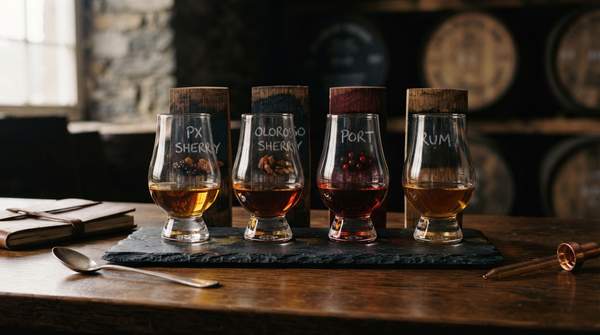
In this guide, I compare four of the most distinctive finishing casks—Pedro Ximénez sherry, Oloroso sherry, port, and rum—drawing on descriptions from producers and specialist retailers to build a framework you can carry into any whisky aisle.
How Finishing Works: The Second Maturation
Cask finishing is secondary maturation: whisky that has already rested in one cask is transferred, often for a shorter period, into a cask previously used for another liquid. Douglas Laing & Co., the independent Scottish bottler, frames the effect in terms of what each cask type adds to the whisky's character; Tenmile Distillery in Wassaic, New York, writing on the craft of cask finishing, adds that the wood itself matters as much as the wine it held—particularly the char level of the barrel, where a heavier char creates more surface area for interaction and can impart smokier, more intense flavors.
The Whiskey Lab, a whisky retailer organized around tasting profiles, makes a point worth internalizing before any purchase: the deeper the cask influence, the richer the resulting profile. Finishing is therefore not a cosmetic flourish but a genuine second act of flavor creation, one in which the spirit absorbs both the residue of its predecessor liquid and new compounds drawn from the wood itself.
Comparative Flavor Profiles of Whisky Cask Finishes
The table below synthesizes the flavor descriptions offered by these sources into a single at-a-glance reference. Use it to match a cask finish to the taste you are seeking—sweet and dessert-like, dry and nutty, berry-forward, or tropical—before you commit to a bottle.
| Cask Finish Type | Original Contents of the Cask | Typical Flavor Notes in the Whisky |
|---|---|---|
| Pedro Ximénez (PX) Sherry | A sweet, dark Spanish sherry made from sun-dried grapes | Dried fruits, dark chocolate, toffee, treacle, fig; intensely sweet and dessert-like |
| Oloroso Sherry | A dry, oxidative sherry wine | Dried fruit, walnut and nutty notes, deep amber color, richness and spice |
| Port (Ruby and Tawny) | Ruby or Tawny port wine; White Port as a fresher variant | Ruby: berries, plums, cherry, blackberry, deep ruby color. Tawny: nuts, caramel, cocoa. White Port: floral, citrus, orchard fruits, creamy sweetness |
| Rum | Rum, a spirit distilled from sugarcane byproducts | Tropical fruit, molasses, vanilla, caramel, warming spice |
Pedro Ximénez Sherry Casks: A Symphony of Sweetness
If your taste runs toward the indulgent end of the spectrum, PX is the finish to seek out. Douglas Laing describes Pedro Ximénez sherry as a sweet, dark Spanish sherry made from sun-dried grapes, and its influence on whisky as indulgent notes of dried fruits, dark chocolate, toffee, and treacle. Tenmile Distillery's account of the craft agrees on the essentials, noting that PX casks contribute intense sweetness and fig-like flavors.
The mechanism is straightforward: the residual sugars and flavors from the sherry are absorbed by the whisky during its second maturation. The result is a dram that reads almost as dessert—think of the raisins, figs, and treacle that The Whiskey Lab groups under its "rich and dried fruit" tasting profile, the world of sherried Scotch at its most concentrated. When I taste a PX-finished whisky, I am looking for that dark-chocolate-and-macerated-fruit richness, with cinnamon often threading through the sweetness.
Oloroso Sherry Casks: Richness and Spice
Oloroso, by contrast, is the drier and more oxidative of the two great sherry finishes. Tenmile Distillery's guide identifies Oloroso sherry casks as providing dried fruit and walnut characteristics, and describes sherry casks generally as the most traditional finishing option—adding rich fruit flavors, nutty notes, and deep amber colors to the spirit.
The distinction from PX matters for your selection: where Pedro Ximénez pushes toward sweetness and dessert, Oloroso's oxidative character yields something nuttier, drier, and more savory. SpecsOnline's barrel-finishing guide, covering sherry finishes broadly, lists toasted nuts like walnuts and hazelnuts, chocolate and cocoa powder, baking spices such as cinnamon, nutmeg, and clove, along with leather, tobacco, or espresso. That final trio of notes signals a more serious, structured dram—sherry influence without the sugar rush.
Port Casks: Berries, Plums, and Chocolate
Port finishing is where the fruit turns red and vivid. Tenmile Distillery notes that port finishing creates some of the most dramatically colored whiskies, often with deep ruby hues, and that the flavor profile typically includes berries, plums, chocolate, and warming spices. Licorea's wine-cask guide adds the crucial nuance: the specific style of port shapes what the whisky takes on.
In a cask that previously held Ruby Port, Licorea explains, whisky may take on a fruitier character, with hints of cherry, plum, or blackberry; the Tawny style, associated with more oxidative aging in wood, may bring notes of nuts, caramel, and cocoa. Douglas Laing highlights a less familiar variant—White Port, a golden Portuguese fortified wine with bright acidity—which steers the whisky floral and citrus-forward, with orchard fruits and creamy sweetness. That acidity is worth noting: Licorea observes that characteristic wine-cask acidity can keep sweetness from feeling flat, although the final balance depends on the whisky as a whole. Port, in other words, is not one finish but a family of them.
Rum Casks: Tropical Fruit and Warm Spice
Rum finishing shifts the register entirely, toward the exotic. The flavors are derived from the residual rum itself and the characteristics of the rum barrel's wood, and they carry the tropical and sweet character of the spirit into the whisky. SpecsOnline's guide to barrel finishes describes rum casks in similar terms—molasses and tropical fruit—alongside the vanilla and caramel that come with sugarcane spirits.
Douglas Laing characterizes the rum finish as tropical, spicy, and warming, with vanilla among its contributions. If PX and Oloroso are the heritage finishes of Scotland and Spain, rum finishing is the passport stamp: it works the same wood-and-residue mechanism, but toward warmth and sweetness of a distinctly sunnier, more indulgent kind than sherry's dried-fruit gravity.
Selecting Your Whisky: A Cask Finish Guide
You can confidently select whiskies by identifying cask finishes that align with your preferred flavor profiles, moving beyond basic age statements to explore these nuanced taste dimensions. The practical test is simple: before buying, articulate the expected flavor notes of the whisky based on its stated cask finish. A whisky finished in a PX sherry cask should have notes of dried fruit, dark chocolate, and toffee; an Oloroso finish should deliver walnuts and drier, spicier depth; a Ruby Port finish should surface berries, plums, and ruby color; a rum finish should offer tropical fruit and molasses warmth.
If a bottle's finish does not support those expectations—if the label names no finish at all—treat that as your signal to ask questions of the retailer before you pay a premium. The finish is not a guarantee of quality, but it is the most reliable predictor of character you have before the cork comes out; it is the one variable you can read, compare, and choose on your own terms.
Sources
- 🥃 The Ultimate Guide to Whisky Cask Finishes — Douglas Laing & Co.
- The Art of Cask Finishing — Tenmile Distillery: Wassaic, New York
- Tasting Profiles — The Whiskey Lab
- Specsonline
- Whisky Finished in Wine Casks: Styles and Flavours — Licorea