When a fine wine is bought as an investment, the buyer is purchasing two things at once: the liquid in the bottle and the paper trail behind it. As WineFi's Oliver Thorpe puts it, "You cannot taste the wine before you buy it. You cannot open the bottle to check if it is still good, because opening it destroys its resale value. Therefore, the only way to know what you are buying is to trust the documentation." That documentation—provenance—combined with verifiable storage under controlled conditions, is what separates a marketable asset from an expensive gamble.
The Foundation of Fine Wine Value: Provenance and Storage
Storage, in the words of WineCap's Desislava Lyapova, is "arguably the most important factor in preserving the quality of a fine wine and is thus fundamentally linked to its value as an investment." A well-documented history of storage and ownership serves as proof of both authenticity and condition, and can significantly increase a wine's value. The inverse is equally true: wines kept in private cellars without comprehensive records may see their market value diminished regardless of their quality or rarity.
What constitutes a "perfect provenance record," according to WineFi, is a history showing the wine went straight from the producer's cellar into professional, climate-controlled storage and remained there its entire life. The Wine International Association frames professional storage as protecting not just the bottles but "your story"—when a future buyer asks where the cases have been, a clean storage record is part of the value itself.
Environmental Pillars of Investment Wine Storage
Four environmental parameters govern whether a wine ages into complexity or degrades into disappointment. Temperature is the most consequential: sources converge on an ideal around 55°F (13°C), with recommended long-term ranges spanning roughly 53–59°F (12–15°C). The Paso Robles Wine Country Alliance, drawing on retired JUSTIN Vineyards sommelier Jim Gerakaris's practices, notes a safe range of 45–65°F (7–18°C) provided it does not swing much day to day—daily changes of 5–8°F or more can damage a bottle quickly even when the average looks fine. Napa Valley Wine Academy's Christian Oggenfuss agrees: "consistency matters more than perfection. Fluctuations are more damaging than being a degree off."
Humidity, light, and vibration complete the picture. Relative humidity of roughly 60–70% keeps natural corks from drying out and admitting air; Interbrosa cautions that too little humidity risks oxidation while too much invites mould on labels and racks, and Wine Guardian Dealer widens the workable band to 50–70%. Light—especially direct sunlight—can "cook" wine, fade labels, and accelerate aging, so dark storage is the standard. Vibration, even small and constant, can alter aromas and flavors, which is why bottles belong away from refrigerators, washing machines, and heavy traffic.
Investment Wine Provenance & Storage Checklist
Use this checklist to evaluate any bottle or case considered for investment: work through each environmental factor and documentation requirement, and confirm the verification method before committing capital. A wine that fails any documentation row carries a provenance gap that the market will price in.
| Factor | Ideal Condition / Requirement | Verification Method |
|---|---|---|
| Temperature | Stable 53–59°F (12–15°C), ideally ~55°F/13°C; consistency matters more than the exact degree | Warehouse temperature logs; cellar monitoring records |
| Humidity | Roughly 60–70% relative humidity (workable band 50–70%) | Warehouse humidity logs; cellar monitoring records |
| Light | Minimal exposure; no direct sunlight; dark, UV-protected storage | Storage facility documentation; visual inspection of labels |
| Vibration | Minimal to none; no agitation in storage or transit | Storage facility documentation; transport history |
| Ownership history | Clear, unbroken chain from winery or licensed importer to current owner | Purchase receipts; auction house archives (previous lot numbers and catalog descriptions) |
| Professional storage records | Continuous bonded-warehouse custody with environmental logs | Temperature and humidity logs from the bonded facility |
The checklist's power lies in what it exposes. WineWiki identifies the most common provenance failures as ownership gaps where no documented owner can be identified for years, vague storage descriptions, conflicting information across sources, and unverifiable claims of romantic origins. For private-cellar bottles, written statements from previous owners or estate executors—with precise dates, acquisition circumstances, and signatures—can partially bridge the gap, but they remain weaker than facility documentation.
Documenting Provenance: The Verifiable History
The strongest provenance documents, per WineWiki, are purchase receipts from the winery or a licensed importer, because they establish a direct chain from the producer. Storage facility documentation from bonded professional warehouses—including temperature and humidity logs—provides objective evidence of appropriate cellar conditions. Auction house archives at Christie's and Sotheby's add a further layer: previous lot numbers and catalog descriptions can be matched to specific bottles.
Transit is a documented weak point. Vint, which inspects and photographs assets on arrival at its partner warehouses and assigns unique identifiers for traceability, notes that wines in transit can be exposed to vibrations and sub-optimal temperatures—meaning a wine that has traveled frequently carries more risk than one that has stayed put.
Professional vs. Home Storage: Implications for Investment
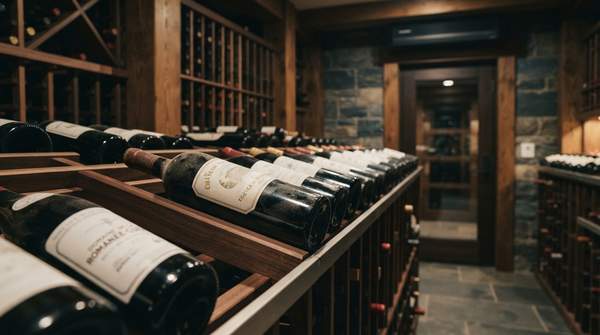
The storage decision ultimately splits into two paths. Bonded warehouses offer temperature-controlled, insured facilities that generate the detailed records investors need; Cult Wines notes that wine stored "in bond" remains untaxed and duty-free, allowing sale or transfer without paying taxes on its increased value, while WineCap observes that bonded status "is what unlocks the secondary market for fine wine." Leaving bonded storage severs that verifiable history.
A home cellar, by contrast, offers direct ownership and personal pleasure, but as InVintory explains, liquidity then "depends entirely on your own effort to find a buyer," and unmanaged temperature, humidity, or provenance gaps directly damage both the wine and its resale value. The Wine International Association adds the practical burdens of space, equipment, and insurance. For an investment-grade case, the trade-off is stark: private storage can be physically excellent, yet without independent records it cannot prove that excellence to a skeptical buyer.
Securing Your Wine Investment: A Proactive Approach
The decision this evidence supports is straightforward: investors should prioritize wines with impeccable, verifiable provenance supported by professional storage records, and ensure ongoing storage adheres to strict environmental controls. The measurable indicator is the presence of comprehensive, unbroken documentation—temperature logs, humidity records, ownership transfers—from a recognized bonded warehouse for any wine considered for purchase or resale.
Before bidding or buying, ask for that paperwork explicitly: the warehouse logs, the receipts tracing the chain to the producer, and any auction lot history. A seller who cannot produce it is asking you to pay investment prices for an unverified story—and the market, when you eventually sell, will make the same demand of you.
Sources
- Why Provenance Matters in Fine Wine Investment — WINEFI
- The importance of wine storage — WineCap
- Building a Wine Investment Starter Plan, Storage, Provenance, and Patience — Wine International Association WIA
- How to Store Wine Properly: Temperature, Humidity & More — Paso Robles Wine Country Alliance
- Wine Investment Guide: A Practical Path to Investing in Wine — Napa Valley Wine Academy
- Wine Cellar Humidity: The 50-70% Rule and What It Costs — Wine Guardian Dealer
- Provenance — Documentation of Wine's Storage and Ownership History — WineWiki by Wine with Seth
- VINT
- How Wine Investment Works: Bottles vs Funds — InVintory