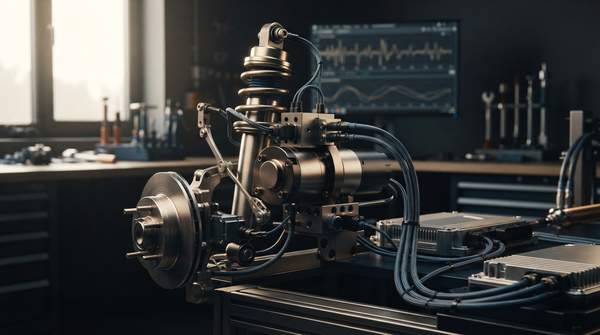
Active suspension is best understood not as a cleverer set of shock absorbers but as a closed-loop control system: an array of sensors feeds data to a dedicated electronic control unit, whose software issues commands to hydraulic or similar actuators that physically manipulate the way the car's body moves over the road. The defining engineering achievement is that the system acts rather than reacts, adjusting each wheel's behavior in a fraction of a second to reconcile two goals that passive suspension forces into compromise: ride comfort and handling precision. That capability, according to industry analysis of the automotive active suspension market, is precisely why the technology remains concentrated in luxury and performance segments, where its substantial costs can be absorbed.
The Intelligent Core: What is Active Suspension?
The conventional passive suspension that underpins most cars relies on fixed-rate springs and dampers. As the encyclopedia definition puts it, passive systems depend "solely on large springs to maintain static support and dampen the vertical wheel movements caused by the road surface." Their behavior is fully determined by hardware chosen at the design stage, and every road input is managed by components that can merely dissipate energy. The wheel and axle move relative to the chassis, and the suspension absorbs whatever the road delivers within the limits of its fixed geometry.
Active suspension departs from this model by adding an onboard control system that governs the vertical movement of the wheels and axles relative to the chassis. Rather than only absorbing shocks, the system can generate and modulate forces at each wheel independently—an industry overview by the engineering company Domin describes the ideal active system as providing "dynamic, real-time control over a vehicle's behaviour," able to adjust stiffness and damping force at each wheel independently. This is the critical distinction: the system does not simply soften a bump after the fact; it shapes the vehicle's response as conditions unfold, stabilizing chassis attitude and balancing comfort with control in a way fixed hardware cannot.
Between the two extremes sits the adaptive or semi-active category. The encyclopedia classification divides the field into true active suspensions and adaptive or semi-active suspensions, and the distinction matters for understanding what manufacturers actually promise. An adaptive system still adjusts—typically varying damper characteristics between preset or continuously calculated states—but it does not independently generate the forces needed to fully counteract body motion. A market analysis by Global Market Insights makes the contrast concrete, noting that compared with active systems there are "no comparably sophisticated high-speed sensors, actuators, and control software" in conventional approaches, which is exactly why costs climb so steeply. The practical consequence for the enthusiast is straightforward: adaptive dampers refine a fundamentally passive response, while a true active system rewrites it.