Luxury car interiors are quietly undergoing one of the most consequential material transitions in a century. Where leather hides and petroleum-based plastics once defined premium cabins, three automakers now illustrate distinct paths to sustainable luxury: Mercedes-Benz has certified the 2026 GLC's cabin as vegan, while Polestar and Lotus have both adopted ECONYL®, a regenerated nylon made from waste such as discarded fishing nets. The shift is driven by changing consumer expectations around ethical and environmental choices, by corporate sustainability commitments, and by material science that can now deliver premium-grade alternatives at scale.
Beyond Leather: Categories of Sustainable Interior Materials
Two broad categories dominate the current wave of sustainable luxury interiors. The first is regenerated synthetics, and its flagship example is ECONYL®, created by the Italian manufacturer Aquafil. Rather than producing nylon from virgin fossil feedstock, Aquafil regenerates nylon from waste streams, including recovered fishing nets. The company states that for every 10,000 tons of ECONYL® raw material produced, 70,000 barrels of crude oil are saved and 65,100 tonnes of CO2 emissions are avoided. Those figures, supplied by the material's creator, quantify why a recycled fiber has become attractive to brands marketing environmental credibility alongside craftsmanship.
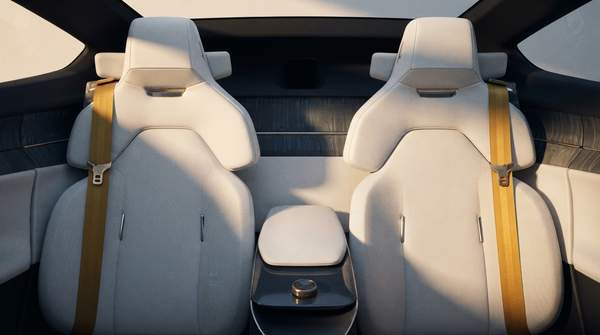
The second category is the animal-free, or vegan, interior, in which traditional leather is replaced by synthetic and textile surfaces that contain no animal-derived ingredients. Mercedes-Benz's approach demonstrates how far this philosophy now reaches: in the 2026 GLC, every soft-touch surface in the Vegan Package — seats, steering wheel upholstery, headliners, door panels, pillars and carpets — has been tested by The Vegan Society, a world-renowned certification organization, and verified as free from animal-derived materials. Crucially, the verification extends beyond the visible surfaces: no animal-based ingredients or additives are used at any stage of production, a standard that covers adhesives and production processes as well as seat covers.
The two categories are not mutually exclusive, and the most complete cabins blend them. Mercedes-Benz pairs its vegan-certified MB-Tex surfaces and textiles with recycled content elsewhere in the vehicle, including floor coverings that incorporate ECONYL® yarn, under its "Design for Circularity" and "Design for Environment" engineering approaches, in which components are designed from the outset with sustainability in mind. The all-new GLC, according to the company, doubles the recycled content in its thermoplastics compared with the current GLC. What unites both categories is a common premise: that luxury in the electric era is defined less by rare animal products and more by the intelligence of a material's origin and lifecycle.
Leading the Charge: Brands and Their Sustainable Material Choices
The clearest way to understand this trend is to compare how each automaker applies these materials, because the philosophies differ even when the materials overlap. Polestar and Lotus, for instance, draw on the same recycled nylon but deploy it in vehicles with very different positioning, while Mercedes-Benz pursues third-party certification rather than a single signature material.
Sustainable Luxury: A Brand-by-Brand Interior Material Comparison
The table below classifies each brand's strategy by model, material and material source, contrasting recycling-based approaches with animal-free certification. Together the three examples show that sustainable luxury is not one strategy but at least two: recovering waste streams to make new fibers, and eliminating animal products entirely from the cabin.
| Automaker | Featured Model(s) | Key Sustainable Material | Material Type/Source |
|---|---|---|---|
| Mercedes-Benz | 2026 GLC (Vegan Package) | Vegan Society–certified MB-Tex surfaces and textiles; recycled-content floor coverings including ECONYL® yarn | Animal-free synthetic and textile surfaces; ECONYL® is regenerated nylon from waste such as fishing nets |
| Polestar | Polestar 3 (released early 2023) | ECONYL® nylon used for all carpet fabric | Regenerated nylon from waste streams |
| Lotus | Eletre, described as the world's first electric Hyper-SUV | ECONYL® nylon applied in its interiors | Regenerated nylon from waste streams |
Polestar's use of ECONYL® across all carpet fabric in the Polestar 3, its ultra-luxury pure electric SUV, reflects what the brand describes as a design-driven approach to achieving sustainability in car manufacturing. Lotus, by contrast, applies the same regenerated nylon in the Eletre as part of a broader interior concept for a vehicle it positions as the world's first electric Hyper-SUV; the specific application within the cabin has not been detailed beyond its interiors. Mercedes-Benz's strategy is the most institutionally verified of the three: the Vegan Society tested and verified all soft-touch interior surface materials in the vehicle, making the certification itself, rather than any single fiber, the mark of distinction.
These examples are illustrative rather than exhaustive, and they capture a moment rather than a finished story. None of them yet tells a buyer how the materials feel over a decade of use, and durability, texture and long-term wear remain questions that only ownership and independent testing can answer. What the comparison does establish is that the materials have moved from concept cars to production vehicles across distinct market segments — a mainstream luxury SUV, an electric performance SUV and a hyper-SUV.
The Future of Luxury: Sustainable Choices as a Standard
Luxury automotive brands are increasingly adopting sustainable interior materials, driven by consumer demand for eco-friendly products and corporate environmental goals. The significance of the Mercedes-Benz certification is that it converts sustainability from a marketing claim into an independently verified product attribute, while Polestar's and Lotus's use of ECONYL® shows recycled fibers performing a role — full carpet coverage — once filled by virgin synthetics. For a buyer, the practical test of this trend is straightforward: ask whether a cabin's materials are certified, recycled or neither. The measurable indicator to watch is continued announcements of new luxury EV models featuring certified vegan interiors, increased use of recycled content, and partnerships with sustainable material suppliers — each new announcement extending a shift that has already moved from niche to production reality.
Sources
- 2026 Mercedes-Benz GLC Sets a New Standard with a Vegan Society–Certified Cabin — Mercedes-Benz of Arrowhead
- Three Ways Manufacturers are Reimagining the Future of Automotive Design — ECONYL® by Aquafil
- A focus on sustainability — Mercedes-Benz Group