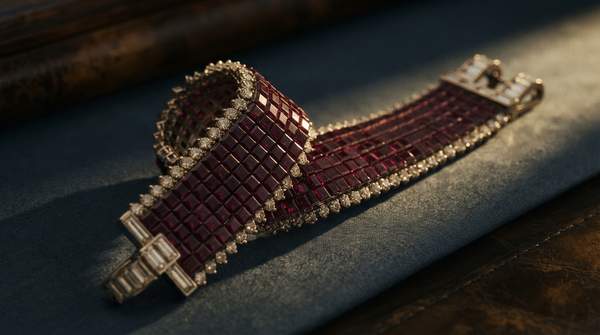
The Mystery Set is Van Cleef & Arpels' answer to a deceptively simple question: how do you secure a gemstone with nothing visible holding it in place? Patented by the Maison in 1933, the technique produces a continuous, seamless surface of stones — an effect the company describes as a velvety sheen — by sliding precisely cut gems onto gold rails hidden beneath them. The result is one of the most recognizable signatures in high jewelry, and one of the least reproducible: according to Van Cleef & Arpels, only very few artisans master its secrets.
Deconstructing the Mystery Set: Jeweler and Lapidary Roles
The technique is best understood as two parallel crafts converging on a single hidden structure. Van Cleef & Arpels describes its secret as lying in "its gold rails, into which stones — expressly and meticulously cut — are individually inserted." The rails and the grooves cut into each stone are interdependent: neither half of the system functions without the other, and the seamlessness of the surface depends on their exact coordination.
| Role | What is created | Key characteristic |
|---|---|---|
| The jeweler | A hidden gold rail framework, shaped to anticipate the metal's dilation during cutting | Lies entirely beneath the stones; visible only from the underside of the piece |
| The lapidary | Each gemstone, cut to order with specific facets and notches | Slides into the rail lattice so the stones, once in place, completely cover the set surface |
The framework in the table is drawn from the Maison's own account of its workshops, which characterizes the jeweler as "part architect part engineer" who must have three-dimensional vision and anticipate how the metal will behave when the rails are cut and the "soul" of the piece is shaped. The lapidary's task — "to dress the jewel" and "illuminate the gems," in the workshops' words — is to select the finest stones from the available batch and cut each one individually so it locks into that lattice.