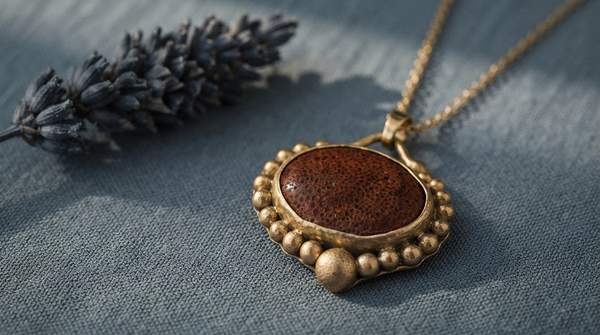
Granulation is the jewelry technique of attaching minute metal spheres—sometimes as small as one three-hundredth of an inch, according to an account of Etruscan work—to a metal surface, building powdery fields of texture from what are essentially individual droplets of gold. What looks like a single shimmering fabric of beads is in fact hundreds of separate joins, each one a small metallurgical problem. Historically, goldsmiths solved that problem in three distinct ways: hard soldering with an alloyed solder, fusing the granules directly to the base metal, and the enigmatic “solderless” route now called colloidal soldering. Knowing which method a piece used is the key to appreciating both its craftsmanship and its place in history.
A Journey Through Time: Granulation's Historical Milestones
The story of granulation is really a story of knowledge won, lost, and laboriously recovered. The technique’s lineage is conventionally traced back to the ancient goldworking cultures of the Near East, but the clearest documented arc in the surviving evidence begins in the Mediterranean. Antique Jewelry University’s account, credited to writer Mary, records that Greek craftsmen practiced granulation, and that the decorative style was carried to Etruria—introduced by Phoenician and Greek craftsmen, it says, in the eighth century BC—where local goldsmiths, already working with advanced metallurgical knowledge, transformed it into something exceptional.
The Etruscans are the technique’s most famous practitioners precisely because of how they did it. Their finest granulation used powder-fine spheres, according to the Antique Jewelry University account, “without apparent use of hard solder”—a mystery that defined the technique for later centuries. That secret was not continuous knowledge. The underlying chemistry was described, for delicate filigree rather than granulation, by Theophilus in the eleventh century and again by Cellini in the sixteenth, before being formally rediscovered and patented as “colloidal hard soldering” by Littlechild in the twentieth century, as David Friedman’s essay on the technique recounts.
The nineteenth-century revival of archaeological-style jewelry—driven largely by admiration of Etruscan excavated work—brought granulation back into fashionable use, and contemporary goldsmiths continue the tradition today, some with laser tools and some reverting to hand-fusing granules in the traditional manner, as the Luna Felix Goldsmith workshop notes.
Mastering the Micro-Spheres: Three Granulation Techniques
All granulation shares a starting point: a formed base—ring, pendant or earring—typically made in high-karat gold, which the in-house goldsmiths at InBloom Jewelry note was chosen by ancient practitioners, often around 22 karat, because of the metal’s ability to fuse without fully melting. The three techniques diverge at the moment of joining. Hard soldering uses a separate, lower-melting alloy placed between granule and base. Fusing uses no added solder at all, relying on temperature alone. Colloidal soldering uses a copper-bearing paste that acts, in effect, as an invisible solder—hence its paradoxical description as solderless soldering. Each method imposes different demands on the goldsmith and leaves different traces on the finished piece.
Comparing Granulation Techniques: A Metallurgical Overview
The table below sets the three methods side by side across their core processes, materials, and historical associations. The decisive distinction is what sits between the granule and the surface: conventional solder alloy, nothing at all, or a copper-bearing paste that alloys in place during firing.
| Technique | Core Process | Materials Used | Historical Association |
|---|---|---|---|
| Hard Soldering | A separate solder alloy is placed at the join and melted to secure the granule to the base. | Base metal and granules plus an external solder alloy. | A long-standing conventional approach; notably distinct from the fine Etruscan work described as done “without apparent use of hard solder.” |
| Fusing | Granules are heated just below melting point so they bond directly to the base metal, with no added solder. | High-karat gold granules and base (gold chosen for its ability to fuse without melting); no external solder. | Ancient practice continued today; some contemporary makers revert to hand-fusing rather than soldering or laser work. |
| Colloidal Soldering | Granules are fixed with a paste of copper salt or oxide, flux and organic glue; firing burns out the glue and the copper alloys into the gold, forming the bond. | Gold granules and base, plus a copper-salt/oxide paste with flux and an organic binder. | Associated with Etruscan mastery (introduced to Etruria in the 8th century BC); the chemistry was later described by Theophilus, Cellini, and patented by Littlechild. |
The comparison makes one point visible at a glance: the more invisible the join, the more sophisticated the chemistry required. Hard soldering is mechanically straightforward but risks visible solder flow at the scale of a powder-fine granule. Fusing demands exquisite temperature judgment. Colloidal soldering, the Etruscan route, achieves the invisible join through a chemical reaction rather than visible alloy.
Fusing: Bonding Without External Solder
Fusing is the purest expression of the goldsmith’s skill with heat. The granules and the base—both in high-karat gold—are brought to a temperature just below the melting point, so that the surfaces weld together into a single continuous metal without any intervening material. The gold itself, as the InBloom account of its goldsmith’s training emphasizes, is the bonding agent. That is why ancient goldsmiths favored roughly 22-karat gold for the base: high-karat gold, with little alloying content, can be coaxed to the edge of melting without collapsing.
The margin for error is narrow by definition. Too little heat and the granule merely sits on the surface, ready to fall away; too much and the sphere loses its shape, flooding into a bump on the base. The Luna Felix workshop observes that even today, some makers deliberately revert to this traditional hand-fusing rather than modern alternatives—an acknowledgment that, for certain textures and compositions, the old method remains the right one. Designers now use fused granulation both in bold, abstract compositions that play with texture and in minimal arrangements where a few individual grains create a delicate effect, according to the same workshop account.
Colloidal Soldering: The Etruscan Secret
The puzzle that defined granulation for centuries was mechanical. As Friedman’s essay on the technique puts it, with granules as small as one three-hundredth of an inch, “it is hard to see how that could be done using solder without flooding the join and converting a granule to a bump.” Ordinary solder, applied at that scale, would capillary into the gap and swallow the sphere. The Etruscan solution—described for filigree by Theophilus in the eleventh century and Cellini in the sixteenth, and patented as “colloidal hard soldering” by Littlechild in the twentieth—was to abandon solder as a discrete material.
Instead, the goldsmith glues each granule in place with a paste combining a copper salt or oxide, a flux, and an organic glue. When the piece is fired, the glue burns away and the copper alloys with the gold at the interface, creating a bond at a lower temperature than outright fusing would require—and, critically, without any visible solder line. The join is achieved by chemistry happening invisibly under and around the granule, rather than by a filler metal flooding the gap. This is the method behind the Etruscan reputation, the one Antique Jewelry University describes as the “mysterious deployment of fine powder granulation” that made Etruscan goldsmiths famous and produced works, in that account’s judgment, of unmatched complexity and beauty.
Appreciating Granulation: A Mark of Master Craftsmanship
For the reader, the practical payoff of this history is a way of looking. Recognize the specific granulation technique used in a piece of jewelry by observing the character of the granule-to-base bond—seamless fusion versus subtle solder lines—and by understanding the historical context of the work. A densely powdered Etruscan-style surface without apparent solder signals colloidal soldering and its demanding chemistry; visible joins point toward hard soldering; and the hand-fused textures favored by some contemporary makers carry the ancient heat-controlled tradition forward. The measurable indicators are the visual characteristics of the bond itself and the historical period of the piece—two things any careful observer can now check against the framework above, and two things that separate a true piece of granulated goldwork from an ordinary textured surface.
Sources
- Granulation and its Techniques — Antique Jewelry University
- Granulation: Solderless Soldering — Daviddfriedman
- granulation jewelry — Blog 1 — Luna Felix Goldsmith
- The Ancient Art of Granulation — inBloom Jewelry