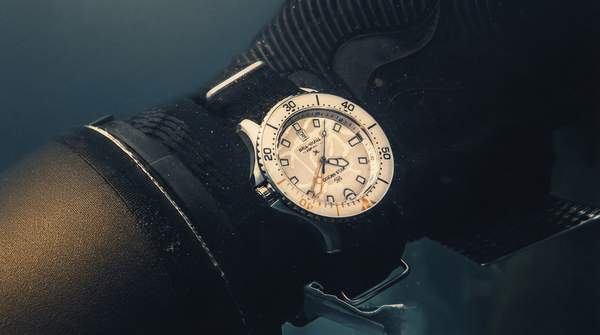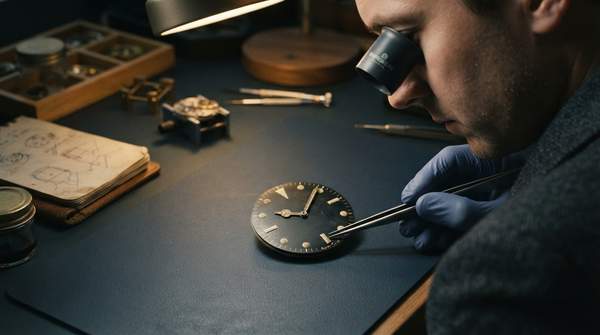
For collectors, the authenticity of a vintage Rolex dial is paramount, as it dictates both the historical integrity and value of the timepiece. A dial's originality can be verified by systematically examining its luminous material, markings, and font characteristics against its production era. Key indicators, such as the text at the 6 o'clock position and the precision of the printing, can reveal whether a dial is original, a later service replacement, or a refinished "redial." Understanding the evolution from radioactive Radium and Tritium to modern Luminova is the first step in spotting anachronisms that expose a non-original part.
The Evolution of Rolex Dials and Lume
The luminous material used on Rolex dials has changed significantly over the decades, primarily due to safety standards and technological advancements. Early timepieces used Radium, a radioactive substance that allowed the hands and hour markers to glow. According to reporting from Bob's Watches, Rolex ceased using Radium by 1963 amid growing health concerns. The company then transitioned to Tritium, another radioactive material but one considered safer. This material was used from the mid-1960s until the late 1990s.
In 1998, Rolex adopted Luminova, a non-radioactive photoluminescent material from a Japanese company, Nemoto and Co. This marked a brief transitional period before Rolex switched again in 2000 to Swiss-Made Super-LumiNova. Since 2008, the brand has used its own in-house luminous material, Chromalight. Each of these materials corresponds to specific markings on the dial, creating a reliable timeline that is critical for authenticating a vintage watch.
Vintage Rolex Dial Authentication Checklist
To systematically assess the authenticity of a vintage Rolex dial, collectors can cross-reference its visible features against known production timelines. This process helps identify period-correct characteristics and flag inconsistencies that may point to a refinished or replaced dial.
-
Check the Lume Marking at 6 O'Clock
The small text at the bottom of the dial is a primary indicator of the luminous material used and, by extension, the production era.- "SWISS": This marking typically indicates a pre-1960s dial with Radium lume. However, it was also used briefly for Luminova dials between 1998 and 1999.
- "SWISS - T<25" or "T SWISS T": These markings signify the use of Tritium and were introduced around 1964 to comply with safety regulations regarding radioactivity.
- "SWISS MADE": This marking appears on dials from 2000 onwards, indicating the use of non-radioactive Super-Luminova or, later, Chromalight.
-
Cross-Reference with the Watch's Serial Number
Every Rolex has a serial number that corresponds to a production year. The dial's features, particularly its lume marking and text style, must match that era. A mismatch is a significant red flag. For instance, a watch with a late-1970s serial number should not have a dial marked "SWISS MADE," as that designation was not used until 2000. -
Examine the Font and Printing Quality
Authentic vintage Rolex models feature "impeccable details and precise printing techniques," according to Affordable Swiss Watches Inc. Closely inspect the text for sharpness and consistency. Look for variations in font style, such as serif or non-serif lettering, which can be correct for certain models and periods but should be consistent with known original examples. -
Inspect for Signs of a Redial
A refinished or repainted dial, known as a "redial," often betrays itself through minor flaws. Look for slightly uneven text, inconsistent spacing between letters, or lume plots that appear messy or do not match the original style for that reference. Purist collectors strongly prefer original, unrestored dials, even those showing age.