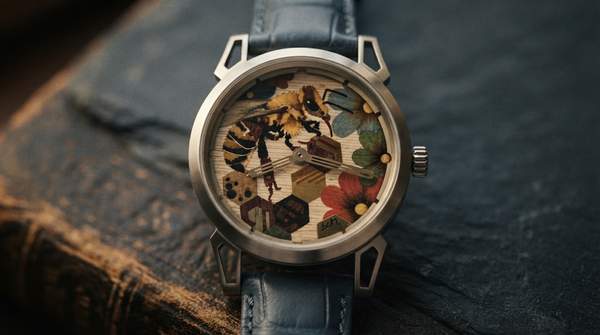
Marquetry on a watch dial is the art of assembling tiny cut pieces of material—wood veneer, straw, stone, shell—into a picture no bigger than a few centimetres across. What separates one marquetry dial from another is largely the material itself: each surface interacts with light in its own way, producing a distinct play of reflection, texture and depth. Understanding those differences is the key to reading, and appreciating, the craft.
Materials and Their Aesthetic Impact: A Comparative Look
The artisans who work in this métier think about materials primarily in terms of effects. Writing in Revolution, Cheryl Chia quotes a Piaget marquetry artisan who explains the logic plainly: "What interests me in materials are the different effects they can give. For example, mother-of-pearl and straw will catch the light while leathers will bring depth."
That distinction—between materials that catch light and materials that build depth—runs through the whole palette. Wood offers a naturalistic, painting-like quality impossible to achieve with enamel's smooth gloss or engraving's metallic reflections; grain patterns add dimension and texture that transcend flat colour fields. Straw, by contrast, is defined by reflectivity: flattened and split rye straw can be dyed vibrant colours, then cut and applied so it catches and reflects light in different directions as the wrist turns. Stone contributes natural pattern and inherent depth, while mother-of-pearl contributes a luminous, iridescent sheen.
Marquetry Dial Materials: Visual Effects and Characteristics
| Material | Primary Visual Effect | Key Characteristic |
|---|---|---|
| Wood | Naturalistic, painting-like depth; grain patterns add dimension and texture, with light interacting differently on the fibrous structure than on vitreous or metallic surfaces—creating depth that shifts with viewing angle | Worked from a palette of mostly natural-coloured veneers, cut and assembled into compositions; achieves effects enamel's gloss and engraving's reflections cannot |
| Straw | Shimmering, iridescent effect that changes with viewing angle, thanks to the natural reflectivity of flattened and split rye straw | Dyed vibrant colours, meticulously cut and applied; its defining property is the ability to catch and reflect light in different directions |
| Stone | Natural patterns and inherent depth, with a subtle play of light; polished surfaces highlight unique inclusions and crystalline structures | Cut into thin, fragile slices from minerals such as malachite, lapis lazuli, aventurine, chrysocolla or meteorite; natural variation ensures each dial is individual |
| Mother-of-pearl | A captivating play of light with a luminous, ethereal quality, arising from its iridescent sheen and natural variations in colour and texture | Derived from mollusc shells—including white and Tahitian varieties—so each piece is unique and no two dials are exactly alike |
Read as a set, the table shows the essential trade-off in marquetry: materials chosen for brilliance, like straw and mother-of-pearl, animate the dial as it moves, while materials chosen for structure, like wood and stone, reward close, static inspection with pattern and depth. The most ambitious compositions combine both—as in the Piaget Altiplano Métiers d'Art Undulata, which Chia describes as mixing sycamore, straw, parchment, trout leather and beetle elytra in shades of green, blue and iridescent hues.