Luxury hotels that integrate nature into their architecture are not merely decorating with plants; they are applying a structured design philosophy. Biophilic design, articulated most influentially in Stephen Kellert's framework, rests on three principles: direct experience of nature, indirect experience of nature, and the human spatial response to place. Understanding these three categories allows a traveler to decode why certain lobbies feel restorative and why certain rooms invite lingering.
Understanding Biophilic Design: An Innate Connection to Nature
The term "biophilia" stems from the Greek words for life and love, and, as the travel journalist Laura Powell has explained, it suggests "man's innate biological connection with nature." It is why a walk in the woods is soothing and why light is stimulating. Biophilic design extends that innate affinity indoors, translating an evolutionary pull toward the natural world into the vocabulary of the built environment.
The scholar Stephen Kellert framed this as more than aesthetics: a commitment to maintaining and enriching the human relationship to nature carries emotional, intellectual, and even ethical rewards, including responsibility for the sustainability of the natural world. In hospitality, this means a hotel's greenery, materials, and spatial planning are not isolated gestures but expressions of a coherent philosophy connecting guest well-being with environmental stewardship.
Principle 1: Direct Nature Connection in Luxury Hotels
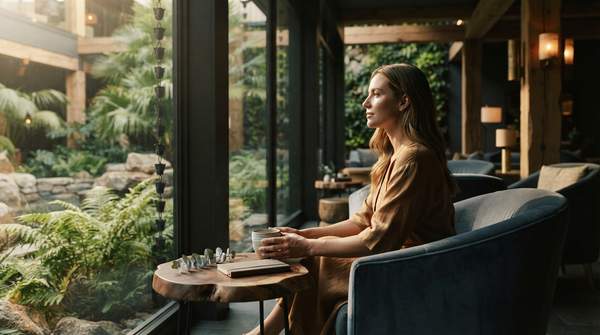
The first principle involves actual contact with natural elements. Kellert's framework lists light, air, water, plants, animals, weather, natural landscapes, and fire as the vehicles of direct experience. In a hotel, this translates into daylight streaming through large windows, indoor landscaping, vertical green walls, water features, and framed views of gardens, rivers, or mountains.
The psychological payoff is well documented in the hospitality literature. Raimondi Horticultural Group, a firm specializing in hotel interiors, notes that environments mimicking nature help reduce stress, improve sleep, boost mood, and promote a general sense of well-being. Guests entering a lobby with natural light, lush greenery, and soothing water features often describe the ambiance as tranquil, refreshing, and luxurious. The Bawah Reserve in Indonesia illustrates the principle concretely: its beach-house villas feature sand-floored open-air living and dining areas that place guests in direct contact with the natural site.
Principle 2: Indirect Nature Connection Through Design
The second principle works through representation rather than presence. Kellert's category of indirect experience encompasses images of nature, natural materials such as wood, stone, leather, and bamboo, natural colors and earth tones, simulated natural light and airflow, and naturalistic shapes and forms that evoke organic patterns.
For a hotel, this is the difference between a living wall and a honeycomb-textured ceiling, a stone bathtub, or a timber-clad suite. These elements carry no literal nature, yet they tap into the same innate preference for natural aesthetics, producing a similar restorative response mediated through design interpretation. The distinction matters for travelers: a property can be deeply biophilic without a single potted plant, if its materials, palette, and textures consistently evoke the natural world. Design Hotels' coverage of biophilic architecture shows how properties blend natural materials and organic forms to achieve a warm, integrated feel that softens interiors and signals craftsmanship, a quality especially resonant in the luxury segment.
Principle 3: Human Spatial Response and Place Conditions
The third principle concerns how space itself shapes experience. The design consultancy Terrapin Bright Green describes this as "Nature of the Space": the innate and learned desire to see beyond one's immediate surroundings, alongside a fascination with obscured views and revelatory moments. Its core patterns are prospect, an unimpeded view over a distance for surveillance and planning, and refuge, the feeling of being safely enclosed.
In hotel terms, prospect is the corner suite oriented toward a river or skyline; refuge is the deep, sheltered reading alcove off the lobby. Genji Kyoto demonstrates the principle deliberately: its floorplan is oriented so that every room has scenic views of the river and mountains, the city, or tranquil private gardens, while gardens dissolve the boundary between interior and exterior. The strongest spatial experiences, Terrapin notes, deliberately combine these configurations with direct and indirect natural elements rather than relying on layout alone.
Biophilic Design in Luxury Hotels: A Framework for Well-being and Sustainability
The framework below categorizes common hotel features by principle, so a reader can identify which strategy is at work and what effect it is intended to produce.
| Principle | What It Means | Typical Hotel Features | Intended Effect |
|---|---|---|---|
| Direct nature connection | Actual contact with natural elements: light, air, water, plants, views | Green walls, indoor landscaping, large windows, water features, sand-floored open-air villas | Reduced stress, improved sleep, elevated mood |
| Indirect nature connection | Representations of nature: materials, colors, patterns, images | Wood and stone finishes, earth tones, organic textures, nature-inspired artwork | Restorative response through natural aesthetics |
| Human spatial response | Spatial layouts serving prospect, refuge, and mystery | Rooms oriented to views, sheltered alcoves, gardens dissolving interior/exterior boundaries | Sense of safety, engagement, and orientation |
To use it: when a feature puts you in contact with living nature, it is direct; when it merely evokes nature through material or motif, it is indirect; when it shapes how you occupy and survey the space, it is spatial. Most compelling properties layer all three.
Dual Benefits: Enhancing Guest Experience and Hotel Sustainability
The business case follows the guest case. Raimondi Horticultural Group reports that properties embracing biophilic design increase repeat bookings and guest loyalty, enhance online reviews, reduce noise and visual clutter, and promote sustainability and environmental stewardship. A 2020 study published in the International Journal of Environmental Research and Public Health, examining rooftop restaurants in hotels, found that biophilic design elements can enhance guest satisfaction and restaurant operations, aligning with the Sustainable Development Goals. Industry commentary likewise frames biophilic principles as part of a broader luxury marketing approach that strengthens brand perception and long-term loyalty.
These benefits should be read with care: the causal link and its magnitude vary with implementation quality and context. But the direction of the evidence is consistent, which is why boutique hotels, luxury resorts, and even urban business hotels are adopting biophilic strategies as a durable shift in how hospitality spaces are conceived rather than a passing fad.
Making an Informed Choice: Recognizing Biophilic Value
When selecting a luxury hotel, prioritize properties that explicitly integrate biophilic design principles to enhance personal well-being and support sustainable practices. Look for visible elements such as abundant natural light, indoor greenery, natural material palettes, and thoughtful spatial layouts that offer both expansive views and intimate spaces. A lobby that pairs a living wall with a timber ceiling and a sheltered lounge overlooking the sea is not accidental luxury; it is a designed response to your biology, and a signal of where the property's values lie.
Sources
- What is Biophilic Design — Journal of Biophilic Design
- Biophilicdesign
- Rethinking Luxury Hotel Design to Connect Guests With Nature — Skift
- Biophilic Design in Hospitality: Enhancing Guest Experiences - Raimondi Horticultural Group, Inc
- The Future of Design: Biophilia in Modern Architecture — - Design Hotels™
- 14 Patterns of Biophilic Design — Terrapinbrightgreen
- MDPI
- Creative Email Design for Resorts & Hotels — Americas Great Resorts