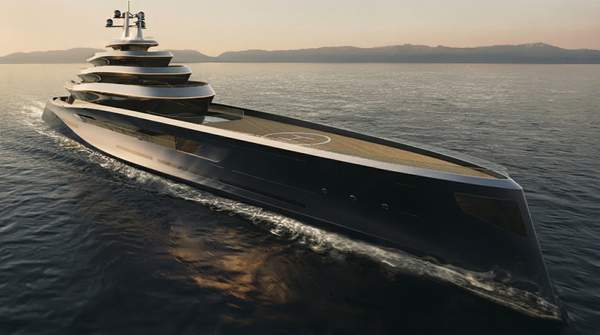
Sustainable superyacht design rests on three pillars: efficient naval architecture that reduces the energy a hull demands, propulsion and energy systems that cut emissions, and eco-conscious materials chosen for origin, durability, and recyclability. Builders across the industry—from Vitruvius Yachts to Sanlorenzo and Sunreef—describe sustainability not as a single feature but as a design philosophy that begins with the shape of the hull and ends with the countertop in the galley. Understanding the framework lets an owner, buyer, or enthusiast deconstruct any builder's sustainability claims and see which pillar each feature actually serves.
The Pillars of Sustainable Superyacht Design
The luxury yachting world is undergoing what Sanlorenzo's UK arm calls a "sea change": environmental impact is now a significant consideration for owners who demand comfort and style without unnecessarily harming the planet. The company reports rising demand for environmentally responsible solutions, with owners seeking to reduce their carbon footprint while preserving prestige and performance, and leading builders responding by integrating hybrid propulsion, advanced hull designs, and sustainable materials. What these scattered practices share is a common logic. Every sustainability measure on a superyacht either reduces the energy the vessel needs to move and operate, changes how that energy is generated and stored, or reduces the environmental cost of what the yacht is physically made from. That tripartite structure—architecture, energy, materials—is the analytical lens this article applies throughout.
Efficient Naval Architecture: The Foundation of Sustainability
The first pillar is the least visible but arguably the most consequential, because every kilogram of fuel saved by hull efficiency compounds across the yacht's entire life. Vitruvius Yachts, the studio of designer Philippe Briand, frames its philosophy around creating "the most efficient possible motoryacht design," drawing on decades of sailing yacht work to optimize hull lines, proportions, and weight. Its 58-meter Najiba, launched in January 2019, was designed by translating that sailing-derived discipline into a motor yacht whose streamlined form reduces the power required to drive it.
The reasoning is foundational rather than decorative: a hull that demands less energy shrinks the burden placed on every downstream system, whether diesel, hybrid, or battery-electric. Sanlorenzo likewise cites advanced hull design among the core innovations builders are integrating to minimize ecological impact. Naval architecture, in this reading, is not merely aesthetic streamlining but the precondition that makes every other sustainability measure more effective.
Sustainable Energy and Propulsion Systems
The second pillar addresses how a yacht generates and uses energy. Hybrid propulsion—pairing diesel engines with electric drives and battery storage—is the most established step, offering fuel savings, reduced emissions, and quieter, vibration-free cruising that also permits access to waters where combustion engines are restricted. Industry reporting by Lauren Beck in The Triton confirms consistent owner demand: Lürssen reports growing interest in diesel-electric propulsion, hybrid systems, larger battery banks, and shore power integration, while Feadship's senior specialist Bram Jongepier says the Dutch yard offers only diesel-electric drives with azimuthing thrusters, with roughly 90% of its in-build fleet using the system.
Beyond hybrids, engine manufacturer mtu has developed a Hybrid PropulsionPack and is exploring green methanol as a fuel, and broader marine research supports R&D into LNG engines and battery-storage hybrid solutions to meet progressively tightening emission limits. Diesel engines still power the majority of new builds, so zero-emission superyachts remain far from the industry standard—but the direction of development is unmistakable.
Eco-Conscious Materials and Interior Design
The third pillar concerns what the yacht is made of, inside and out. Sunreef Yachts' Eco program offers concrete examples: interior floors of reclaimed teak salvaged from old houses, boats, and other wooden structures; countertops of compressed paper-based materials that are weight-efficient, solid, and easily repaired, since scratches can be removed by applying heat; and decking of ethically sourced teak, cork, or recyclable non-PVC synthetic alternatives. Its Eco catamarans also carry fully recyclable sails, with retired sailcloth gaining a second life as durable bags and accessories.
Sunreef's broader guidance on sustainable interiors stresses two principles that apply to any material choice: local sourcing, because short transport chains mean a lower carbon footprint, and durability, because solid materials that last for years need no replacement. Timeless design, the builder argues, is itself a sustainability measure, since interiors that do not go out of fashion remain in use rather than in landfill.
Sustainable Superyacht Design Framework
Use the table below as a diagnostic tool: when a builder or broker presents a sustainability feature, place it in one of the three pillars and ask what specific technology or material substantiates the claim. A feature that cannot be assigned to a pillar—or that arrives with no named technology, material, or measurable effect—deserves closer scrutiny.
| Design Pillar | Approach or Technology | Contribution to Sustainability | Qualification |
|---|---|---|---|
| Efficient Naval Architecture | Optimized hull lines, proportions, and weight | Reduces the energy demand the yacht places on all downstream systems | Aims to cut energy demand as the foundational step for overall sustainability |
| Sustainable Energy & Propulsion | Hybrid and diesel-electric drives, larger battery banks, shore power | Fuel savings, lower emissions, quiet cruising, access to restricted waters | Diesel still powers most new builds; zero-emission yachts are not yet the standard |
| Sustainable Energy & Propulsion | Alternative fuels: green methanol (mtu), LNG engines and battery-storage hybrids | Targets progressively tightening emission limits | Under active research and early integration rather than widespread adoption |
| Eco-Conscious Materials | Reclaimed teak flooring, compressed paper-based countertops, cork and non-PVC synthetic decking, recyclable sails | Cuts marine waste and demand for virgin resources | Chosen for durability, repairability, and timeless aesthetics as well as origin |
| Eco-Conscious Materials | Local sourcing and long-life, quality materials | Short transport chains lower carbon footprint; durable materials avoid replacement | Applies to interior décor and construction choices alike |
The framework's value is in the categorization itself: hull efficiency, energy systems, and materials each attack the yacht's environmental footprint through a different mechanism—demand, supply, and physical composition—and a genuinely sustainable design addresses all three rather than resting on a single headline feature.
The Evolving Landscape of Superyacht Ownership
For owners, the shift is financial as much as ethical. Sanlorenzo reports that yachts with hybrid propulsion, energy-efficient systems, and responsibly sourced materials are commanding greater interest and retaining value over time, and frames investing in a greener yacht today as "peace of mind for tomorrow." The reasoning extends beyond fuel savings: sustainable features can future-proof an investment against obsolescence as environmental standards tighten and buyer expectations evolve. Sanlorenzo attributes the change to a new generation of buyers who expect lifestyle choices, including yacht ownership, to align with their environmental principles—a demand that has reshaped design, technology, and innovation across the market. The practical consequence is that sustainability is migrating from marketing language to specification sheet, where it can be verified against the three pillars above.
Making an Informed Choice: The Future of Sustainable Luxury
Prospective superyacht owners should prioritize designs that integrate efficient naval architecture, advanced energy systems, and eco-conscious materials to ensure long-term value, reduced operational costs, and alignment with evolving environmental expectations. The measurable indicator to watch is the increasing prevalence of hybrid propulsion systems, alternative fuel compatibility, and certified sustainable materials in new build specifications and refit projects. A buyer evaluating a specific design can apply the framework directly: confirm the hull was engineered for efficiency, identify the propulsion architecture and its battery or alternative-fuel capability, and trace the interior materials to a verifiable reclaimed, recycled, or responsibly sourced origin. A yacht that satisfies all three tests is not merely fashionable—it is built for the market that is arriving.
Sources
- Design philosophy for sustainable superyacht design - Vitruvius Yachts — Vitruvius Yachts by Philippe Briand
- Sustainability & innovation in luxury yachting — Sanlorenzo Yachts UK
- THE RISE OF SUSTAINABLE INTERIOR DESIGN — Sunreef Yachts
- Power Moves: The Future of Superyacht Propulsion — THE TRITON
- Hybrid Systems for Yachts — MTU Solutions
- MDPI
- Sustainable Finishing Materials and Designs for Yachts — Sunreef Yachts Eco