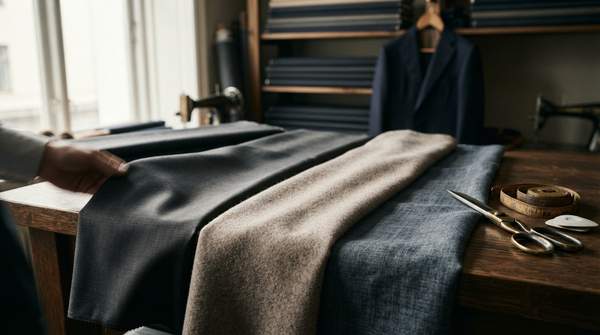
The best luxury suiting fabric is not the most expensive one—it is the one matched to your climate, your rotation, and your occasions. Super 150s Merino wool offers year-round versatility and refined drape; a cashmere-wool blend delivers exceptional softness and warmth for cooler weather; and a linen blend provides superior breathability and relaxed elegance for summer. Each choice involves a genuine trade-off between drape and breathability, wrinkle resistance and seasonal comfort, and durability and luxury feel. This guide lays out those trade-offs so you can walk into a tailoring consultation knowing exactly what to ask for.
Understanding Luxury Suit Fabrics: Super 150s Wool, Cashmere Blends, and Linen
These three fabrics occupy distinct positions in the luxury tailoring landscape. Super 150s Merino wool sits in what H.M. Cole's fabric guide calls "true luxury territory," pairing elevated softness with a clean, structured drape suitable for smart to formal occasions year-round. Cashmere-wool blends, common in winter sport coats and luxury suits according to Vestium NY, combine cashmere's plush softness with the structural integrity that pure cashmere lacks. Linen, by contrast, is the warm-weather specialist: Sartoro's fabric reference rates it the most breathable of the common suiting fibers, with a cool, dry, casual character that wrinkles freely.
The essential decision variables are consistent across sources: seasonality, formality, drape, breathability, wrinkle resistance, and durability. No single fabric wins on all of them. Wool dominates on versatility and resilience, cashmere on tactile luxury and warmth, linen on air circulation and summer comfort. The right choice depends on which of those qualities your wardrobe actually needs.
The 'Super S' System: Demystifying Wool Fineness
The "Super S" number, ranging from the 80s to upwards of 200s, is a technical classification referring to the average diameter of the raw wool fiber before it is spun into yarn—the higher the number, the finer and thinner the individual fiber. As Oliver Wicks' tailoring guide explains, this fineness directly shapes the fabric's character, and in fine tailoring higher numbers are understood to indicate a more luxurious and refined cloth. Super 150s therefore signals a very fine fiber whose smoothness translates into an elevated, crisp feel against the skin.
But fineness is not durability. Sartoro's guidance is blunt: once you go much beyond Super 130s, the cloth turns more delicate, creasing and snagging more easily and wearing out faster—so finer is more luxurious, not more durable. Bhambi's Custom Tailors frames the same trade-off from the buyer's side: "Very high Super numbers, while extraordinarily luxurious to the touch, can be more delicate and less resilient than their lower-numbered counterparts. The right Super number is not the highest one available — it is the one suited to how and where you will wear the suit."
That said, the delicacy of Super 150s is often overstated. Oliver Wicks argues that for a professional maintaining a rotation of several suits, a Super 150s garment is more than capable of handling daily wear. The practical conclusion: Super 150s rewards rotation and mindful care rather than constant, solitary use.