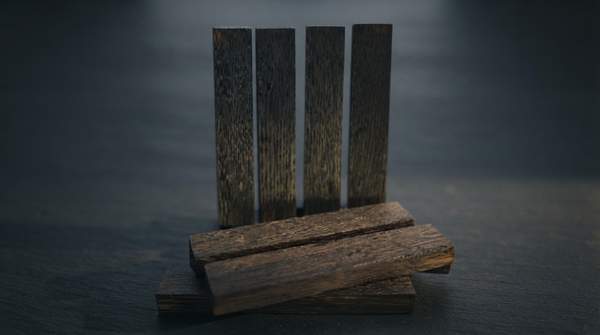
When I lift a glass of well-matured whiskey and find vanilla on the nose, caramel on the palate, and a creamy coconut lift on the finish, I am tasting chemistry that began years earlier inside a charred oak stave. Those signature notes are not accidents of distillation; they are the measurable products of heat breaking down wood polymers into small, aromatic molecules that the spirit then extracts over time. The vanilla traces to lignin, the caramel to hemicellulose, and the coconut to oak lactones drawn out of the wood itself. Understanding which layer of the barrel produced which compound transforms tasting from vague impression into a traceable science.
The Oak Barrel: A Dynamic Flavor Factory
The barrel is not a passive container; it is the single most consequential flavor-generating instrument in the entire whiskey-making process. Whiskey barrel aging is the sum of five major processes happening at once, each contributing different compounds and flavor changes to the evolving spirit. The wood itself is programmed before the barrel is ever filled: as The Epicurean Trader describes, every new barrel is subjected to heat treatment — toasting, charring, or both — that radically changes the chemical profile of the wood surface and determines both the rate and the character of flavor extraction during aging.
What the fire does, in essence, is pre-digest the oak. Innerstave, a cooperage-focused publication, describes the mechanism plainly: the major wood components change chemically when heat is applied, and those changes create precursors for flavor and color reactions. When those heat-generated precursors meet the alcohol, water, and oxygen inside the filled barrel, the reactions that generate mature bourbon's aromas and flavors finally take place. The barrel, in other words, is loaded with potential chemistry that only a spirit can unlock.
Layer by Layer: Chemical Transformations Within the Stave
The most useful way I have found to picture a charred stave is as a stack of distinct reactive zones, each running its own chemistry. Working from the inside of the barrel outward, The Epicurean Trader's cross-section of the stave identifies a char layer of roughly one to four millimeters, a red or caramelized zone beneath it, and then the deeper active wood that the spirit physically penetrates by two to eight millimeters in warm summer conditions.
The char layer is the least glamorous but quietly indispensable. It functions as activated carbon filtration, removing harsh compounds from the spirit — sulfur, aldehyde, and traces of methanol — while the pyrolyzed wood also delivers fast color extraction. This layer primarily filters rather than creates new flavor, which is why its contribution is felt as smoothness rather than as a note you could name.
Beneath the char sits the red layer, where heat has caramelized the wood's own sugars. Hemicellulose, a sugar polymer in the oak, breaks down under the toasting and charring process into simple sugars — Innerstave names mannose and xylose among them — which then yield furfurals and related compounds that read as caramel and sweetness. The Epicurean Trader's stave map places the highest concentrations of vanillin precursors, eugenol, and guaiacol in this caramelized zone as well, making it a dense reservoir of flavor potential.
Deeper still, beyond the char and red layers, the active wood zone works more slowly. There, lignin — the complex structural polymer of oak — gradually depolymerizes into vanillin, syringaldehyde, and p-coumaryl aldehyde, while oak lactones in both cis and trans forms are extracted into the spirit. Ellagitannins in the same zone contribute astringency and act as oxidation catalysts, meaning the wood is not only supplying flavor molecules but also helping drive the reactions that soften the spirit over time.