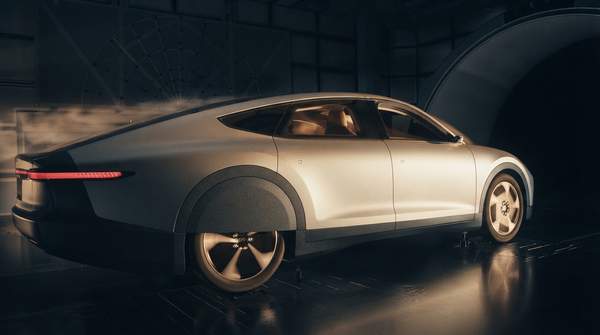
Luxury electric vehicles do not settle for a single aerodynamic shape. Instead, they deploy movable components—adaptive rear spoilers, active diffusers, and front wheel deflectors or air curtains—that reshape airflow as driving conditions change. The engineering logic is a trade-off: a low-drag profile extends range on long journeys, while added downforce sharpens stability and performance at speed. The Porsche Taycan, whose rear spoiler extends to three positions depending on the driving situation, illustrates how a single component can serve both masters.
The Core Principle of Active Aerodynamics in EVs
Passive aerodynamics fixes a car's airflow behavior at the design stage; active aerodynamics makes it conditional. A vehicle that slices through the air with minimal drag conserves battery energy, which is why efficiency-minded EVs chase the lowest possible drag coefficient. Yet minimal drag and maximum grip pull in opposite directions: components that press the car into the road for stability typically add wind resistance. Active systems resolve this tension by retracting when efficiency matters and deploying when performance demands it.
For electric vehicles specifically, the payoff of drag reduction is range rather than fuel economy. Magna, the component supplier that develops active spoilers, wheel deflectors, and diffusers, frames the objective plainly: for combustion vehicles the focus is improved fuel consumption and reduced emissions, but "for electric vehicles, the focus is to extend range." The company quantifies the individual contribution of its devices at fuel savings of 0.06 to 0.37 liters per 100 kilometers, depending on the device and vehicle, with compounded savings possible when products are combined.
Adaptive Spoilers: Balancing Efficiency and Grip
The active rear spoiler is the most visible expression of the range-versus-performance trade-off. Advanced versions automatically adjust their position and angle based on driving conditions, providing downforce for traction and stability during high-speed maneuvers or cornering, while reducing drag at lower speeds to improve efficiency.
Its application varies by body style, according to Magna: on sports cars, decklid spoilers typically aim to improve handling performance by changing the vehicle's downforce or lift, whereas the active spoilers Magna develops for sedans and SUVs focus on reducing the coefficient of drag. The Porsche Taycan demonstrates both purposes in one mechanism. Depending on the driving situation, its spoiler extends to three different positions, influencing the car's drag and rear lift. Porsche describes the result as a car that can be conditioned for best efficiency and range on long journeys, or set up with the lowest possible rear-axle lift to deliver characteristic sports car performance and the fastest lap times on a race track.
Active Diffusers: Enhancing Stability from Below
Where the spoiler works on airflow above the decklid, the active rear diffuser works underneath the car. Magna explains that the Active Rear Diffuser takes the airflow from under the vehicle and redirects it to optimize the flow directly behind the rear of the vehicle. By managing how air exits the underbody and reattaches in the car's wake, the diffuser shapes one of the most drag-sensitive regions of the entire vehicle.
Magna notes that both the diffuser and its front-end counterparts work toward the same goal—providing an aerodynamic benefit—and that the two products differ mainly in their location on the vehicle. The company also sees substantial aerodynamic potential in the SUV segment, where larger frontal areas and taller bodies leave more room for underbody airflow management to pay dividends.
Active Wheel Deflectors and Air Curtains: Streamlining the Front
The rotating wheels and open wheel arches are among the draggiest elements of any car, which is why active systems cluster at the front. Magna's Active Front Wheel Deflectors help shape the airflow around the front tires, guiding air past the wheels rather than letting it churn inside the arches. Dynamic air curtains, located near the front wheels, serve a similar managing function.
Mercedes-Benz demonstrated how far this front-end strategy can go with a concept whose active elements, as the company described, included front bumper flaps extending 25 millimeters forward and 20 millimeters rearward to improve airflow around the front end and front wheel arches, active rims altering their cupping from 55 millimeters to zero, and a rearward-moving bumper louvre improving underbody airflow. At speed, the concept's drag coefficient dropped to 0.19, minimizing wind resistance and thereby extending vehicle range.
Comparative Overview of Active Aerodynamic Components
The table below categorizes the three principal active systems by location and primary aerodynamic goal, clarifying which components serve range and which serve performance—and under what conditions each operates.
| Component | Location on Vehicle | Primary Goal (Range vs. Performance) | Typical Activation Condition |
|---|---|---|---|
| Active rear spoiler | Decklid (sedans, sports cars) or liftgate (SUVs) | Both: reduced drag for efficiency, or increased downforce for stability, depending on tuning | Adjusts position and angle automatically with driving conditions; extends at higher speeds for downforce, retracts or lowers for efficiency |
| Active rear spoiler (Porsche Taycan) | Rear deck | Both: lowest drag for efficiency and range, or lowest rear lift for lap-time performance | Extends to three positions depending on the driving situation |
| Active rear diffuser | Underbody, at the rear | Drag reduction by optimizing airflow behind the vehicle | Varies by vehicle; redirects underbody airflow to shape the wake |
| Active front wheel deflectors / air curtains | Front bumper and wheel arch area | Range: drag reduction by improving airflow around the front wheels | Deploy to guide air around the front tires and along the vehicle's sides |
The comparison makes the division of labor explicit: front-end components exist almost entirely in service of range, while the rear spoiler is the one component that genuinely straddles both goals, switching between them as speed and driver intent change.
Porsche Taycan's Integrated Aerodynamic Strategy
The Taycan shows how these elements combine into a coherent whole rather than a collection of gadgets. Its three-position rear spoiler is the headline act, but Porsche pairs it with active cooling air flaps and, as the company notes, the aerodynamic possibilities offered by its air suspension—lowering the body at speed to reduce drag further. Each element addresses a different airflow region: the spoiler manages rear lift and drag, the flaps control how much air enters the cooling system, and the suspension trims the car's overall profile.
The result is a vehicle that no longer asks its owner to choose between a grand tourer and a track car. On a long journey, the Taycan conditions itself for the lowest useful drag; on a circuit, it reconfigures for minimal rear lift. That conditional character—efficiency and performance as software-selected states rather than fixed design compromises—is precisely what distinguishes active aerodynamics in the modern luxury EV.
Optimizing EV Dynamics: A Continuous Aerodynamic Balance
Luxury EV manufacturers will continue to integrate and refine active aerodynamic systems to dynamically balance the competing demands of extended driving range and superior performance. The measurable indicator to watch is concrete: future EV models will feature increasingly sophisticated and integrated active aerodynamic elements, with manufacturer announcements highlighting specific improvements in drag coefficient or downforce figures. When the next generation of electric flagships is unveiled, the drag coefficient and the number of deployable aero surfaces quoted in the specification sheet will reveal exactly how far this balance has advanced.
Sources
- Aerodynamics: The best value of all current Porsche models — Porsche Newsroom
- MAGNA
- Mercedes to maximize electric car driving range with active aerodynamics — Digital Trends